USSR

 Play sound
Housing construction pace
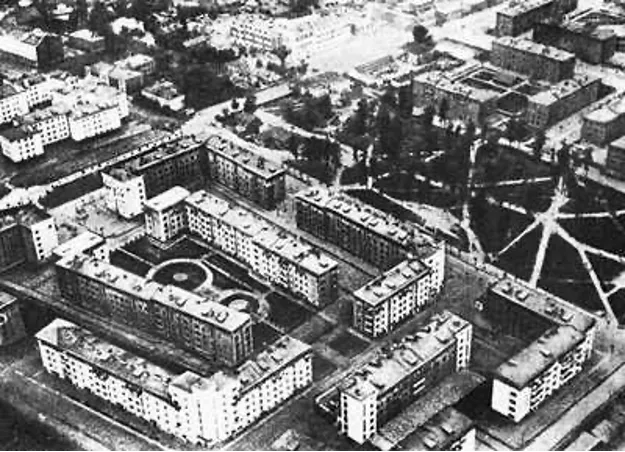
During accelerated industrialization, the emphasis was placed on industry, but the rapid growth of the proletarian population required a speedy solution to the housing issue. New “socialist cities” arose - neighborhoods with social infrastructure, focused on the concept of “socialized life.” Prominent architects participated in the design, but the main limitation was the need to quickly build and accommodate workers. In 1930–1933, the Soviet leadership invited a group of 17 German and Austrian architects led by Ernst May, an ideologist of mass standard construction. Based on their designs, blocks were built in Novokuznetsk, Magnitogorsk, Novosibirsk, named after the industries.
In Moscow, constructivist neighborhoods appeared in the areas of Usachevka, Shabolovka, Dangauerovka, and Rusakovsky. Moses Ginzburg, the Golosov brothers, Konstantin Melnikov, the Vesnin brothers, and Alexey Shchusev worked on the projects. The block on Shabolovka (project 1927) was distinguished by a diagonal layout and maximum use of sunlight. The southern facades with balconies faced the living rooms, the northern facades led to the kitchens. The area between the houses is occupied by courtyards with greenery; kindergartens, schools, and outpatient clinics have been built. The apartments were spacious, 2–3-room, designed for family occupancy. However, the reality turned out to be different: due to restrictions on materials, working families received only part of the apartment; they remained communal. The emotions of that time are reflected in the poem by Vladimir Mayakovsky, “The Story of Foundry Worker Ivan Kozyrev about Moving into a New Apartment,” where the bathroom symbolizes the arrival of socialism.
Another eminent architect of the era, Ivan Zholtovsky, was an opponent of constructivism, considering it a simplification. He returned classics to the architecture of the USSR, following the traditions of Andrea Palladio. The house on Mokhovaya became a turning point. Over 65 years of activity, Zholtovsky built more than 100 buildings. He reconstructed the Moscow Hippodrome and built the building of the Stroganov School. In the post-war years, he built residential buildings in the classical Renaissance style, receiving the Stalin Prize for his design of a house on Leninsky Prospekt. Zholtovsky argued: “A person needs beauty, it elevates him.” During the war, he did not leave Moscow, protecting his house from bombs. His workshop planned cozy neighborhoods in Perov and Izmailovo.
After the Great Patriotic War, the European part of the country lay in ruins, but it was during these difficult years that symbolic buildings appeared. The conceptual meaning was to show: the people have survived and are ready for new achievements. The construction of seven “Stalinist high-rise buildings” in Moscow (1949–1953), including the main building of Moscow State University and the building on Kotelnicheskaya Embankment, dates back to this period. Each was a masterpiece of architecture and symbolism. They demonstrated that the Soviet Union was capable of grandiose decisions, aimed at the sky and would prove its global primacy and faith in the future.