USSR

Automotive industry
Development of the USSR Automobile Industry
Automobile manufacturing became an important and dynamically developing industry in the USSR. In the pre-war period, the key factories were GAZ in Gorky, YarAZ in Yaroslavl, ZIS and KIM in Moscow. ZIS and YarAZ developed enterprises established as early as 1916; the first AMO-F-15 trucks rolled off the ZIS assembly line in 1924. In the post-war period, major enterprises were established in Minsk and Lvov, and factories founded during the war (Ulyanovsk, Miass) continued to develop. In the 1960s, industrial giants were built in Naberezhnye Chelny (KAMAZ) and Togliatti (VAZ) with full urban infrastructure. Plants were opened in Zaporozhye, Kremenchug, Lutsk, Riga, Yerevan, Kutaisi, Pavlovo, Likino and other cities.
In 1990, the USSR ranked 8th in the world in passenger car production, trailing the leaders, but 3rd in trucks (after the USA and Japan). Truck production fully met the needs of the national economy. Specialized equipment was supplied from socialist countries and the West, and export trade was conducted.
Volga Automobile Plant (VAZ)
In 1970, the first mass-produced car was released in Togliatti. VAZ became the largest automobile assembly plant in Europe. In 1974, the plant reached its design capacity of 660,000 vehicles per year.
KAMAZ
In 1976, the plant in Naberezhnye Chelny produced its first output. Over 2.5 million vehicles and 2.85 million engines were manufactured. Capacity was 150 thousand trucks and 250 thousand engines per year. The construction of the plant was accompanied by the creation of social infrastructure: housing, schools, hospitals, and cultural facilities. A powerful industrial center was created in the Kama River region.
AMO – ZIS – ZIL
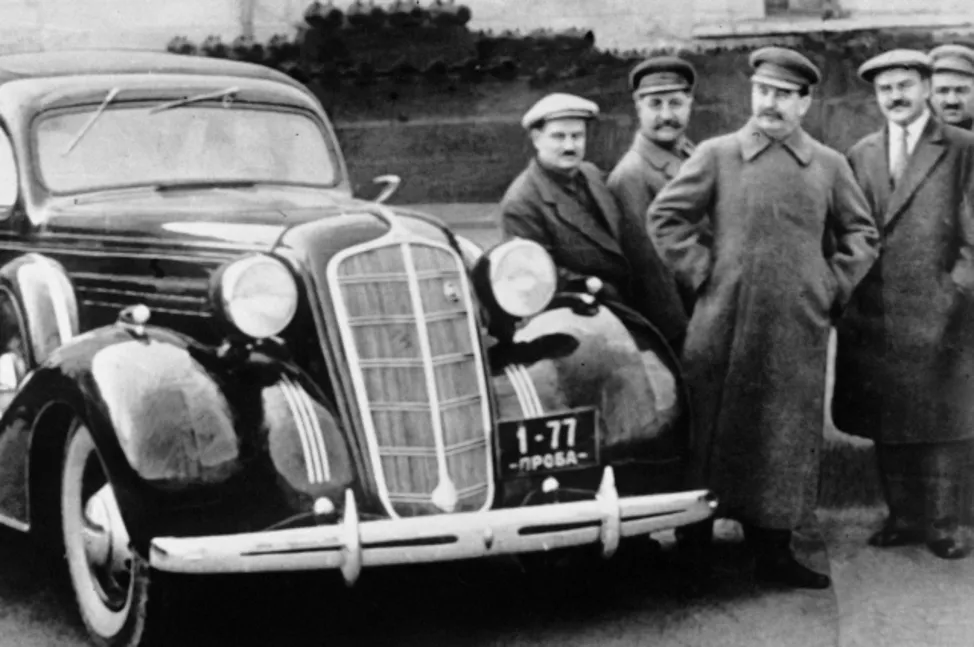
On December 30, 1926, Ivan Likhachev was appointed director, which became the starting point of the Soviet automotive industry. The plant transitioned from producing the AMO-F-15 to the ZIS-5 model. In 1931, the first assembly line in the USSR was launched (the AMO-3 model). In 1933, production of the ZIS-5 began. In 1934, the first batch (100 units) was exported to Turkey. Under Likhachev, output grew from 350 to 23,000 vehicles per year (1934). He studied the experience of Henry Ford. The ZIS-5 truck became the "workhorse" of the Red Army during the war. During the war, five evacuated enterprises were put into operation. In 1956, ZIS was renamed ZIL (Likhachev Plant). The ZIL-130 truck (from 1964) became the most mass-produced Soviet truck (3.5 million units).
KIM – MZMA – AZLK
The KIM plant was established in 1930 with the participation of the Ford company. Ford-A and Ford-AA models were assembled. In 1939, production of the KIM-10 compact car began. In 1945, the plant was renamed MZMA. The basis for the new model was the German Opel Kadett K38. From 1947, the Moskvitch-400 and Moskvitch-401 were produced. Subsequent models were in-house designs. Moskvitch cars were actively exported. In 1968 and 1970, Soviet teams driving Moskvitch cars successfully competed in the London–Sydney and London–Mexico City rallies.
Gorky Automobile Plant (GAZ)
The decision to build the plant was made on March 4, 1929 (design capacity of 100,000 vehicles). An agreement was signed with Ford Motor Co. On January 1, 1932, the plant began operations (GAZ-A, GAZ-AA). In 1933, a road rally Moscow – Kara-Kum – Moscow (9,500 km) took place. The chief designer was Andrei Lipgart. The GAZ-M1 ("Emka"), GAZ-M20 ("Pobeda"), GAZ-51, GAZ-12 "ZIM", and GAZ-67 were created. During the war, the plant produced T-60 and T-70 tanks, GAZ-64 vehicles, shells for "Katyusha" rocket launchers, and mortars. Over the course of the war, more than 176,000 vehicles, 10,000 tanks, and 9,000 self-propelled guns were produced. After the war, the model range was updated: the "Pobeda" (with a "wingless" body), the GAZ-51 truck (3.48 million units), the "ZIM", GAZ-69, "Chaika" (GAZ-13, GAZ-14), and "Volga" (GAZ-21, GAZ-24). The "Volga", "Chaika", and GAZ-52 models received the Grand Prix at the Brussels Exhibition (1958). The GAZ-66 was awarded a gold medal in Leipzig (1967). The GAZ-24 received a gold medal in Plovdiv (1969).
Yaroslavl Automobile Plant
The plant was founded in 1916 due to a shortage of transport during World War I. After the revolution, it was nationalized. The first model was the Ya-3 "Yaroslavets" truck (1925). It produced trucks (3.5–12 tons), buses, dump trucks, and trolleybuses (including double-decker ones). By 1940, output had grown 26 times compared to 1926. During the war, it switched to military production and established diesel engine manufacturing. After the war, it specialized in diesel engines and components (Yaroslavl Motor Plant, now "Avtodiesel"). Truck production was transferred to the Minsk Automobile Plant.
Minsk Automobile Plant (MAZ)
The decision to build was made in 1944–1945. In 1947, the first MAZ-205 trucks participated in a parade. In 1950, production of 25-ton MAZ-525 dump trucks began. The plant became the flagship producer of heavy trucks for construction projects in the USSR. In 1964, the 200,000th vehicle was produced. In 1970, production of the MAZ-500 began. The plant continues to operate after the collapse of the USSR.
BelAZ
Construction began in 1948. In 1958, the first 25-ton dump truck was produced. In 1960, a 40-ton model followed. In 1965, the BelAZ-540 was awarded a gold medal in Leipzig. The plant continued to increase payload capacity: 80 tons (1968), 110 tons (1977), 200 tons (1982), 280 tons (1990). After the collapse of the USSR, BelAZ remained a world leader, creating a dump truck with a 450-ton payload capacity in 2013.
Ulyanovsk and Miass Plants (UAZ, Ural)
UAZ was founded in 1941 on the basis of the evacuated ZIS production. In 1942, the first ZIS-5 trucks were assembled. The "Ural" plant (Miass) traces its history to November 30, 1941 (evacuation of the ZIS foundry production). The first "ZiS-5V" truck rolled off the line on July 8, 1944.
Kremenchug Automobile Plant (KrAZ)
Founded in 1958 on the basis of a combine harvester plant. The first trucks were produced in 1959 based on YaGAZ documentation. In 1965, production of the KrAZ-257, 258, and 256B models began, which remained on the assembly line for 30 years. In 1984, the 500,000th vehicle was produced.
Zaporozhye Automobile Plant (ZAZ)
In the late 1950s, the goal was to create a cheap, compact car. The "Moskvitch-560" project was transferred to the "Kommunar" plant (Zaporozhye). In 1960, the first batch of the "Zaporozhets" (ZAZ-965) was assembled with an air-cooled engine. The export version was called "Yalta". Later, models 966 and 968 were produced.
Bus Plants
Bus production was concentrated at specialized plants.
- LiAZ (Likino-Dulyovo): From 1970, it produced the LiAZ-677 model.
- PAZ (Pavlovo): From 1952, it produced small-class buses. The PAZ-652 and PAZ-672 models were known for their high off-road capability for rural areas.
- LAZ (Lvov): Founded in 1945. The first model was the LAZ-695 (1956). It produced tourist buses and equipment for cosmonauts (1963–2013). A total of 365,000 buses were produced.
- RAF (Riga): Produced the RAF-977 and RAF-2203 "Latvia" minibuses. They were used as taxis, ambulances, and shuttle buses. A symbol of reliability of the Soviet era.
There were also plants in Yerevan, Kutaisi, Kaunas, Tartu, Chkalovsk, Lugansk, Chernigov, Kurgan, and Krasnodar.
Summary
The legacy of the Soviet automobile industry is significant. Many plants continue to operate, preserving their brands. Models such as "Volga", "Moskvitch", "Ural", and "KAMAZ" have become part of history. The experience of creating the VAZ and KAMAZ complexes demonstrates the possibility of implementing large-scale projects. The industry continues to develop on the foundation laid during the Soviet period