1941 –
1945
USSR

Great Patriotic War
The beginning of the war and the Battle for Moscow
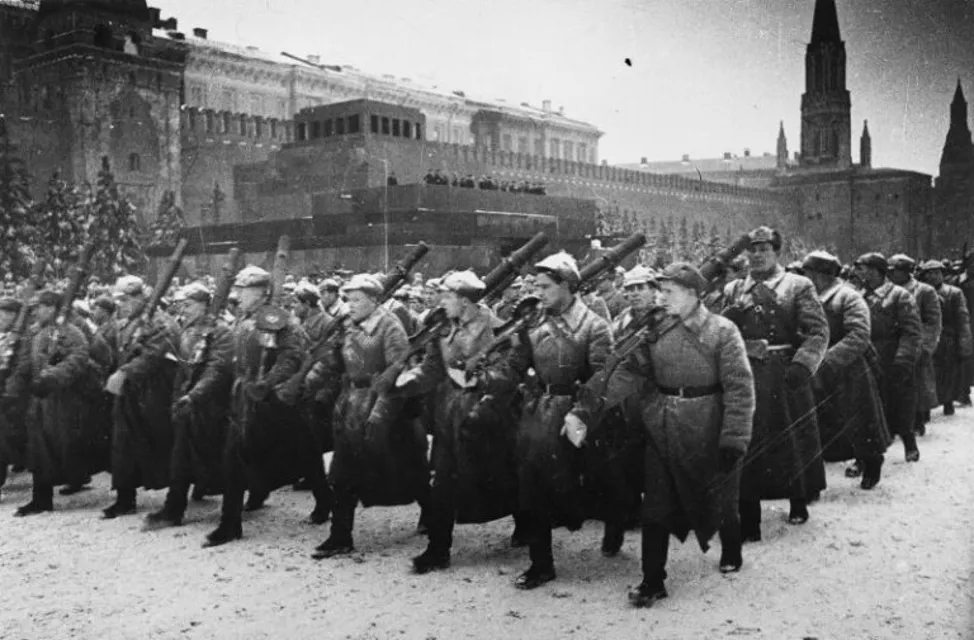
On June 22, 1941, Germany and its allies treacherously attacked the USSR. By autumn the enemy had seized significant territories, approached Moscow, and blockaded Leningrad and Sevastopol. Despite massive bombings and the difficult situation at the front, on November 7, 1941, a military parade was held on Red Square, with troops going from it straight to the front. A key role in stabilizing the situation was played by intelligence: Richard Sorge reported that Japan would not attack the USSR. This made it possible to redeploy fresh divisions from the Far East to the Moscow area. The railway workers performed the impossible, transporting armies in 10–20 days. In December 1941, Soviet troops launched a counteroffensive, driving the enemy back from the capital. The "Barbarossa" plan failed. Richard Sorge was executed in Japan on November 7, 1944, becoming a symbol of the heroism of intelligence officers.
1942: defense and the start of the turning point
In the south, the defense of Sevastopol lasted 250 days, until July 1942. In December 1941, the Kerch–Feodosia landing operation became the largest amphibious landing of the war, making it possible to liberate the Kerch Peninsula and prevent the threat to the Caucasus. The defense of the Adzhimushkay quarries ended tragically: about 15,000 fighters and civilians held the defense in the underground for months, perishing from gas and hunger. In the summer of 1942 the enemy was striving toward the oil of Baku and the Volga. The Battle of Stalingrad ended with the rout of Paulus's grouping and served as the start of the radical turning point in the war.
1943: the Kursk Bulge and the allies
In 1942–1943, fierce fighting unfolded near Rzhev. Holding the "gates to Moscow," the Germans concentrated their best forces here. The battle for Rzhev pinned down Army Group "Centre," preventing it from being redeployed to Stalingrad. In the summer of 1943, the Battle of the Kursk Bulge became the largest tank engagement in history. After it, the Wehrmacht lost the capacity for strategic offensives. An important role in the battle for the Caucasus was played by the "Malaya Zemlya" bridgehead near Novorossiysk. In November 1943, at the Tehran Conference, the leaders of the USSR, the USA, and Great Britain confirmed the timing of the opening of the second front.
1944–1945: liberation and Victory
On January 27, 1944, the blockade of Leningrad — which had lasted 872 days — was lifted. From hunger and disease more than 630,000 civilians perished. In the most difficult months, Leningraders received 125 grams of bread. The "Road of Life" across the ice of Lake Ladoga and the railway "Road of Victory" became symbols of resilience. From 1944 the liberating mission of the Red Army in Europe began. Soviet troops liberated Romania, Bulgaria, Yugoslavia, Poland. More than 1 million Soviet soldiers gave their lives for the liberation of Europe. Entering the territory of the enemy, the soldiers discovered the horrors of the concentration camps, such as Auschwitz, where 1.5 million people perished. The unity of the front and the rear was ensured by the evacuation of industry to the east, organized under the leadership of A. N. Kosygin and N. M. Shvernik. May 9, 1945, became Victory Day. The USSR lost 27 million people and suffered colossal destruction, but it endured.
Outcomes of the war and justice
In August 1945, the Soviet Army crushed the Japanese Kwantung Army. On September 2, 1945, Japan signed the act of surrender, ending the Second World War. An important outcome was the Nuremberg Trials (1945–1946). On the initiative of the USSR, an international tribunal was established to punish Nazi criminals. Twelve defendants were sentenced to execution (10 of these sentences were carried out). Aggression was recognized as a crime against humanity, and the highest figures of the Reich were condemned. The openness of the trial allowed the world to learn the truth about the atrocities of Nazism in the occupied territories.