1919 –
present
USSR

Eradication of illiteracy
After the revolution of 1917, the Soviet state faced the acute problem of mass illiteracy. According to the 1897 census, only about 24 percent of the Empire's population was literate, and in some regions the figure was critically low. The Bolsheviks regarded the elimination of illiteracy as a task of paramount political and economic importance. Without a literate population, it was impossible to build a modern industry. For this reason, already in the first years of Soviet power, a large-scale campaign began, which came to be known as likbez (the elimination of illiteracy). On December 26, 1919, the decree of the Council of People's Commissars of the RSFSR "On the Elimination of Illiteracy Among the Population of the RSFSR" was signed. The document obliged the entire population between the ages of 8 and 50 to learn to read and write. To implement this task, a special network of schools and likbez centers was established. All literate people, including teachers and students, were drawn into teaching. Instruction was often conducted in the evening, so as not to take adults away from production. Funding was provided from the budget, and textbooks were distributed free of charge.
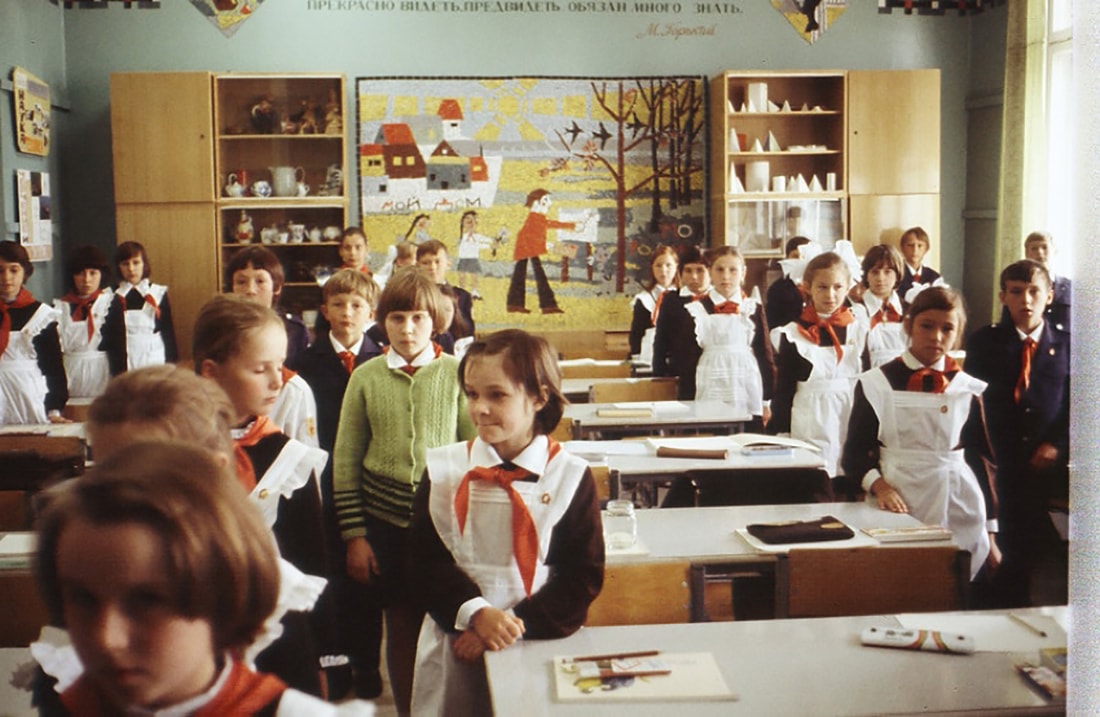
The campaign was nationwide in character. By the mid-1930s, the main tasks of likbez had been accomplished. Whereas in 1926 literacy stood at about 56 percent, by 1939 this indicator had risen to 87 percent. By 1959, illiteracy in the USSR had been practically eliminated entirely. This became one of the most significant social achievements of Soviet power. The state did not stop at simply teaching reading and writing, and it began the construction of a systematic education. In 1930, universal compulsory primary education was introduced. Every child had to complete at least four grades of school. In the postwar period, the system continued to develop. In the 1950s, the transition to universal seven-year education was carried out. The school reform of 1958 placed an emphasis on linking school with life, introducing elements of polytechnic education. By the 1970s, universal secondary education, implying the completion of 10 grades, had been introduced in most of the union republics. The curricula were unified across the country. Education at all levels was free of charge. Alongside school education, the system of higher and specialized secondary education developed rapidly. The Soviet government needed qualified engineers and scientists. To prepare working youth for admission to institutions of higher education, workers' faculties (rabfaks) were established. They allowed people without a complete secondary education to receive preparation and enter university. In the 1920s and 1930s, priority was given to technical specialties, which corresponded to the tasks of industrialization. The number of higher educational institutions and students grew at a rapid pace. Whereas in 1914 the Russian Empire had around 100,000 students, by 1980 in the USSR their number exceeded 5 million.
An important feature of the Soviet educational system was its ideological orientation. The upbringing of a new human being, a builder of communism, was considered an integral part of the educational process. The study of Marxism-Leninism was compulsory in institutions of higher education, and in schools there were the Pioneer and Komsomol organizations. Despite the ideologization, fundamental education in the natural sciences was at a very high level. This was confirmed by the successes of Soviet scientists. The system also paid attention to supplementary education. There was a broad network of Palaces of Pioneers, music schools, and art schools. National policy in the field of education provided for instruction in the native languages in the republics, which contributed to the development of the cultures of the peoples of the USSR, along with the simultaneous study of the Russian language.
By the 1980s, the Soviet Union had achieved one of the highest levels of literacy in the world. According to UNESCO data, the USSR held leading positions in the number of readers and engineers per capita. The educational system provided a social ladder for millions of people from working-class and peasant families. The children of ordinary workers could become academicians or cosmonauts. The legacy of the Soviet school remains significant to this day. The elimination of illiteracy and the creation of an accessible system of education remain one of the main outcomes of the existence of the Soviet state.