1920 –
present
USSR

Soviet energy industry
The GOELRO plan and the beginning of electrification
In December 2025, 105 years pass since the GOELRO plan — the plan for the electrification of Russia, the first Soviet mega-project. Without this plan, the country's accelerated development, the formation of industrial capacity, and scientific and technical progress would have been impossible. In 1921, the English science-fiction writer H. G. Wells came to a Russia exhausted by world and civil wars. He met Lenin, who told him about the prospects for industrialization, universal electrification, the elimination of illiteracy, and the restoration of the country. Being a science-fiction writer, Wells did not believe Lenin, calling him "the dreamer in the Kremlin" in his book "Russia in the Shadows." Lenin advised Wells to come back in ten years and see for himself the results of the planned undertakings.
Statistics and first steps
Before the revolution, the capacity of all Russian power plants was 1.1 million kW. Per capita, 14 kWh was generated; in the USA at that time this figure was 236 kWh. In tsarist Russia there were several power plants, but they were not interconnected in a grid. The GOELRO plan became the matrix from which all subsequent plans grew. The electrification of regions was tied to the development of industry. In November 1920, a year before the official adoption of the plan, in the village of Kashino near Moscow, peasants who had united in the rural cooperative "Zarya" built the first Soviet power plant, which ran on diesel. The peasants wrote a letter to Lenin, who came to the village for the opening of the station and screwed in the first electric light bulb. From this comes the catchphrase "Ilyich's lamp."
Engineers and peat
At the head of the technical part of the plan stood talented and enthusiastic Soviet engineers: Gleb Krzhizhanovsky, Robert Klasson, Karl Krug, Boris Ugrimov, and Heinrich Graftio. The electrification commission included 240 people, 90 of whom worked on a permanent basis. Robert Klasson, even before the revolution, had built near Moscow the first power plant in the world that ran on peat. In conditions where Russia had no coal, peat became salvation. In 1925, the power plant in Shatura, running on peat — the reserves of which in this district were enormous — was put into operation.
Growth of capacity
The country's electrification plan provided for the development of energy generation united in a grid and of industrial enterprises on the basis of the energy produced. In 1925, the total capacity of power plants amounted to 1.4 million kW; in 1935 generation reached 26.8 billion kWh. When Wells came to the USSR again in 1934, electricity generation was over 21 billion kWh. In 1945, the USSR entered the world's top three in installed power-plant capacity and electricity generation.
Atomic energy
In 1954, the first NPP — the Obninsk plant — was opened. In all, during the Soviet period, 20 nuclear power plants were built and put into operation. The most powerful nuclear power plant in the USSR and Europe was the Zaporizhzhia NPP, which began operating in 1984. Its six reactors with a total capacity of 6 GW generated 20% of Ukraine's electricity. The world's first mobile NPPs were created (TES-3 and "Pamir"). In 1956, the Unified Energy System of the European part of the USSR appeared.
Hydroelectric power
A large-scale program for the construction of hydroelectric power plants (HPPs) was implemented in the country. The first HPP built within the framework of the GOELRO project was the Volkhov HPP. Construction began in 1921 and was completed with the launch of the station in 1926, with a reach of full capacity in 1927. Next to the station, the first aluminum plant in the USSR — the Volkhov Aluminum Plant — began work. During the Great Patriotic War, the station supplied electricity to besieged Leningrad through a cable laid along the bottom of Lake Ladoga.
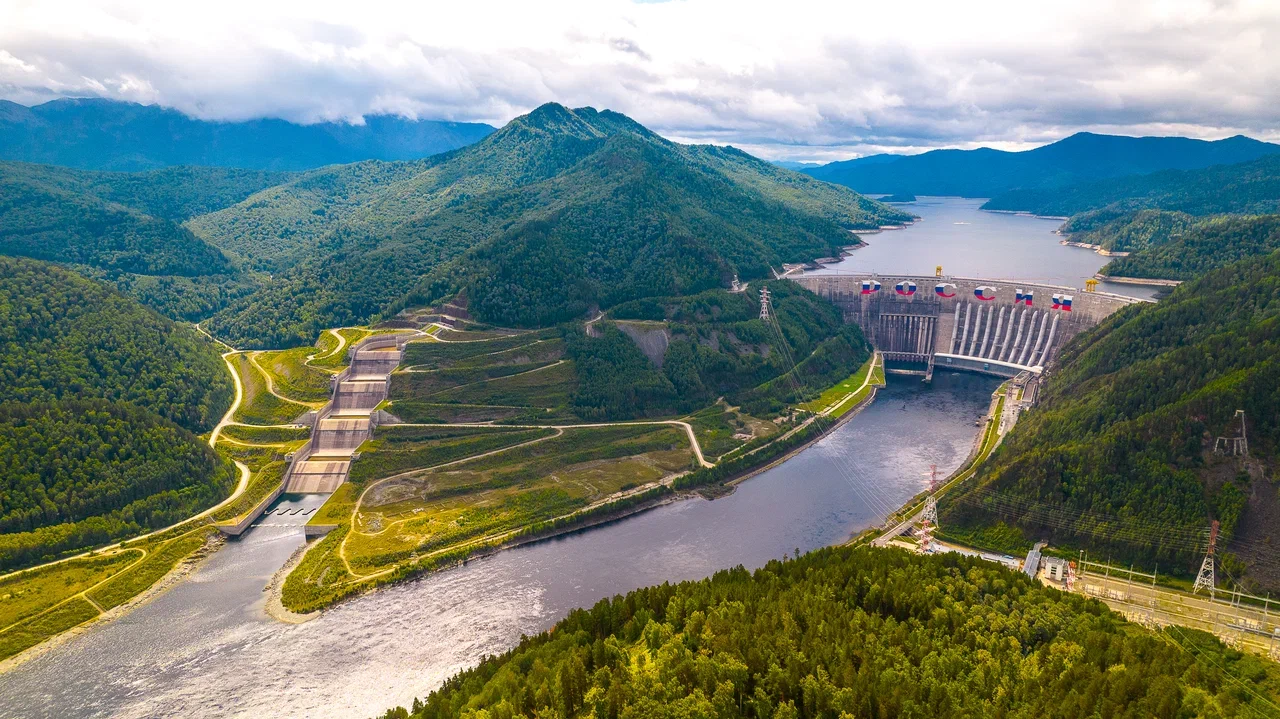
The first giant of Soviet hydropower became the Dnieper HPP (DniproHES). The construction of the station continued for 5 years, from 1927 to 1932. In 1961, the Volga HPP named after Lenin came into operation, which at that moment became the most powerful in the world (2541 MW). The Bratsk HPP, built in 1967, became a symbol of the space age. Its capacity was 4500 MW. In 1972, the Krasnoyarsk HPP with a capacity of 6000 MW was launched, which again became the most powerful in the world. In 1985 the Sayano-Shushenskaya HPP with a capacity of 6400 MW was put into operation.
The Siberian energy cluster
Together with the Irkutsk HPP and the Ust-Ilim HPP, they formed the most powerful Siberian energy cluster, which made it possible to create on their basis the most powerful aluminum production based on 4 large aluminum plants: the Bratsk, the Krasnoyarsk, the Irkutsk, and the Sayan. At that time, the Bratsk and Krasnoyarsk aluminum plants were the largest in the world and held these positions for a long time. The Sayano-Shushenskaya HPP is located in the upper part of the Yenisei; not far from it, on the right bank of the Yenisei, lies the historic village of Shushenskoye, where Lenin was in exile in 1897–1900. The height of its arch-shaped dam is 242 meters!
Outcomes of Soviet energy policy
In 1989, in the USSR, a record was achieved in electricity generation — 1643 billion kWh. Exports of electricity to the CMEA countries amounted to 33.6 billion kWh. The capacity of the stations was 341 GW.