USSR

Soviet circus
No one born in the USSR doubted that the Soviet circus was the best in the world.
After the revolution, with the support of the state, circus art is actively developing. The decree on the creation of state circuses in the USSR was signed in August 1919.
In 1957, the All-Union Association “Soyuzgostsirk” was created. In the 1970s, it operated 61 stationary circuses, 14 national circus groups, 15 traveling circuses, a Circus on Water, two Circus on Ice, 55 Circus on Stage groups and 13 zoo circuses.
After the civil war, there were 10 state circuses in the country, including two in Moscow. There weren't enough artists for everyone. However, at this moment the chairman of the International Artistic Lodge approached the Soviet government with a request to help unemployed German circus performers and invite them to work in the arenas of the USSR. The Soviet government supported the request and foreigners came to Soviet Russia, solving the personnel issue. Spectators had the opportunity to see the best acts available in the world at that time; circuses were extremely popular.
By the beginning of the 30s, Soviet circus art had developed its own unique and easily recognizable style. The idols of the public at that time were the clown Karandash (M. N. Rumyantsev), aerialists Valentina and Mikhail Volgin, tightrope walkers brothers Svirin and Pavel Tarasov.
In 1936, the film “Circus” with music by Isaac Dunaevsky was released on the country’s screens. The march from this film immediately became the main march of all Soviet circuses.
In 1941, circus performers went to the front en masse. The artists who remained in the rear performed for soldiers on the front line and in hospitals for the wounded, at train stations and in military registration and enlistment offices.
In the post-war years, the professionalism of Soviet circus performers reached an unprecedented level. At the First International Festival of Circus Arts, held in Warsaw in 1955, the Soviet circus program took first place. She was awarded a gold medal and a diploma.
At the same time, national fame came to Yuri Nikulin. Finding himself in the circus studio by accident, he first entered the arena in 1948, and soon after that he became Pencil's assistant. A little later, the Soviet circus was enriched with another talent - Oleg Popov, the Solar Clown.
Circus dynasties worked in the Soviet circus, such as the Durovs (clownery with the participation of trained animals, “theater” of animals), Zapashny (tamers), Kio (tactics), Filatovs (tamers), Kantemirovs (riders), Bagdasarovs (tamers).
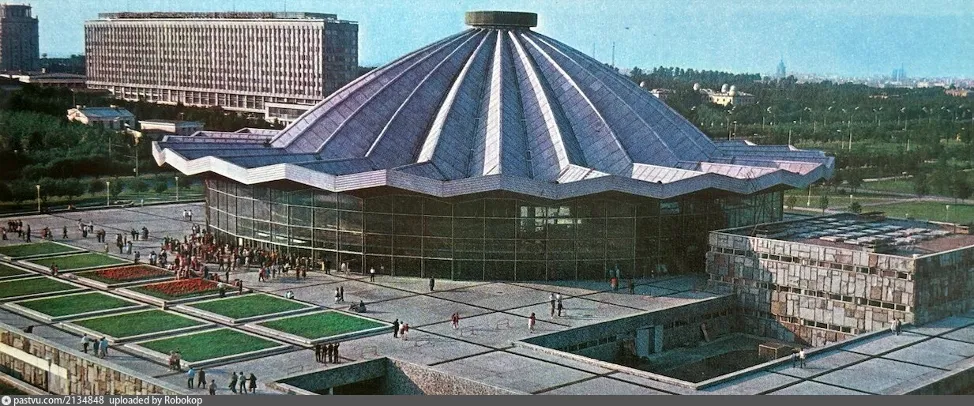
The new building of the Moscow circus on Vernadsky Avenue (Great Moscow Circus) was opened on April 30, 1971. It has a system of five quickly changing arenas, including an ice and water arena. A wonderful project was made by the outstanding Soviet architect Yakov Belopolsky. The auditorium seats 3,400 people. This is the largest circus in Europe