USSR

Soviet sport
Chess and football
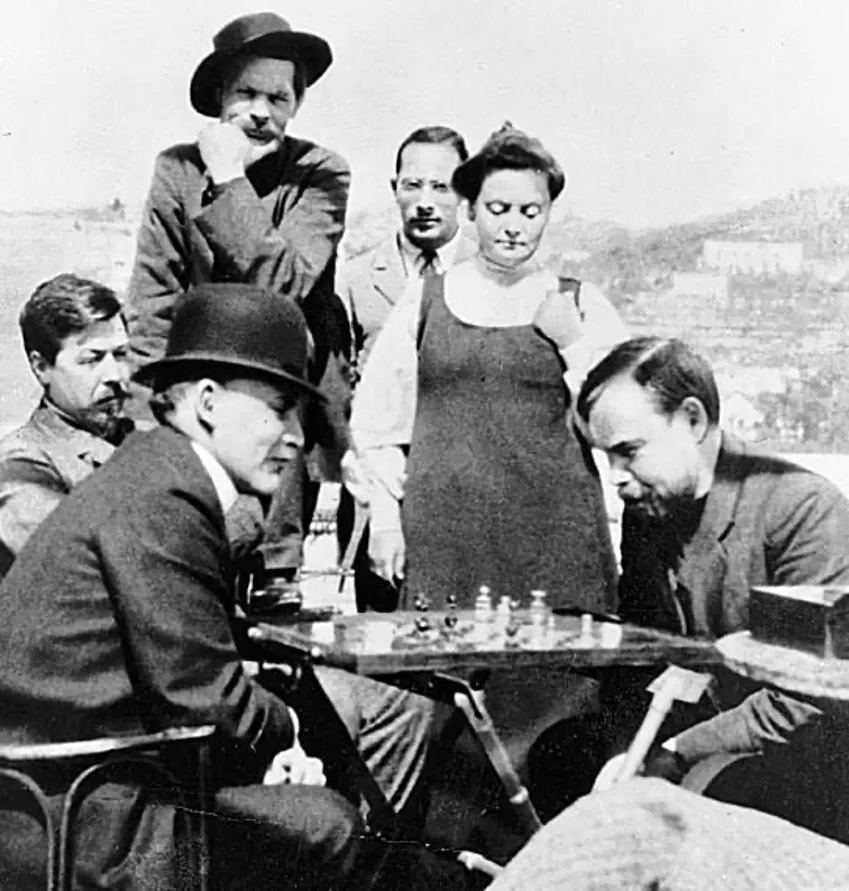
Soviet sport was mass, beloved, and successful. The main thing is that any sport in the USSR was accessible and popular. The fashion for chess in Soviet Russia was largely supported by Lenin — the game was one of his favorite pastimes. In 1925, an international chess tournament was held in Moscow with the participation of José Raúl Capablanca, Emanuel Lasker, and other outstanding chess players.
All kinds of sports were popular in the USSR. The winner of the very first European football championship in history, in 1960, was the USSR national team. In the final, the Soviet team met the Yugoslav national team. The very fact of two teams from socialist countries meeting in the final of the European championship is significant. The combination involving Valentin Bubukin, Yuri Voinov, Slava Metreveli, and Mikhail Meskhi ended in a goal by Viktor Ponedelnik. As the famous Soviet sports commentator Nikolai Ozerov said: "Ponedelnik scored on Monday."
The 1972 Olympic Games
At the 1972 Olympics in Munich, gymnast Olga Korbut performed a unique element on the uneven bars, which entered history as the "Korbut Loop." Today such an element is recognized as risky and is banned by the rules. At this same Olympics, the Soviet sprinter Valery Borzov became the fastest man on the planet, winning the sprint double.
The phenomenally tense and intriguing final match USSR — USA is to this day considered perhaps the most dramatic match in the history of basketball. Before this match the USA basketball team had never once lost at the Olympics — not a single game. Victory was taken on the last second. The hero of the last shot was Sergei Belov.
Figure skating
In the spring of 1973, the World Figure Skating Championships took place in Czechoslovakia, in Bratislava. The new Soviet pair Irina Rodnina and Alexander Zaitsev prepared their performance carefully. Their coach Stanislav Zhuk especially watched for getting in time with the music. For this purpose he brought a metronome to training sessions. With its help the figure skaters learned and memorized the rhythm of the routine.
During the skaters' performance, the music suddenly disappeared. The figure skaters realized that they were skating in silence. The support of the spectators, who kept the rhythm of the musical composition with their applause, helped. The judge whistled, trying to stop the routine. But Irina and Alexander did not stop the program — the athletes themselves sang the melody, continuing to skate. At the end of the routine the pair looked at the stopwatch. It turned out that the athletes had performed the program one second faster. The stadium applauded. The chief judge offered the pair either to skate the entire program over again or to leave everything as it was. The second option implied that the figure skaters' marks would be reduced for the violation of the prohibition on skating without music. The chief judge turned to the arbiters. Almost all the judges gave 5.9 out of a possible 6.0.
Athletics and ice hockey
In 1952, the USSR national team made its debut at the Olympic Games. The first USSR Olympic champion became Nina Romashkova-Ponomareva (athletics, discus throw). The hero of the 1956 Melbourne Olympics in running was Vladimir Kuts. That Olympics was even unofficially named after him — "the Kuts Olympics."
On December 22, 1946, the first matches of the USSR ice hockey championship were played. Over the following decades, our hockey players won all the major tournaments — the Olympic Games, world championships, the Izvestia newspaper cup tournaments, and the Canada Cups. The Soviet hockey national team in the 1980s received the name "Red Machine." In 1954, the USSR national team, under the leadership of Arkady Chernyshev, came to the debut world championship in Stockholm, Sweden, and sensationally won. Outstanding coaches stood at the head of our hockey national team in different years: Arkady Chernyshev, Anatoly Tarasov, Vsevolod Bobrov, Boris Kulagin, Viktor Tikhonov. Each player on the USSR hockey national team was a real star.
The 8 matches of the "Super Series" USSR — Canada, played in 1972 in Canada and Moscow, became legendary. In 1974 a second similar tournament took place. In 1981 the Canada Cup was held, at which the USSR national team routed the tournament hosts with a score of 8:1.
Gymnastics and weightlifting
Alexander Dityatin was called the "gymnast with wings." At the 1980 Olympics in Moscow he won three gold medals, four silver, and one bronze — a medal in every event. There had been no such result in history. His technique was impeccable, his style flawless. He entered the Guinness Book of Records and became the absolute record-holder of the Olympics.
It was said of Larisa Latynina that she brought ballet to gymnastics. Only one woman has won nine Olympic gold medals — Larisa Latynina. In all — 18 awards. Yuri Vlasov, Yuri Vardanyan, and Vasily Alexeev are stars of weightlifting. Vardanyan lifted 405 kg in the total of two lifts (snatch and clean and jerk) at his own weight of 81 kg. Vasily Alexeev set 80 world records and 81 USSR records. Alexeev is the holder of the "eternal" world record in the total of three lifts — 645 kg (since the bench press was excluded from the program after 1972).