Turkey

 Play sound
Kemalism
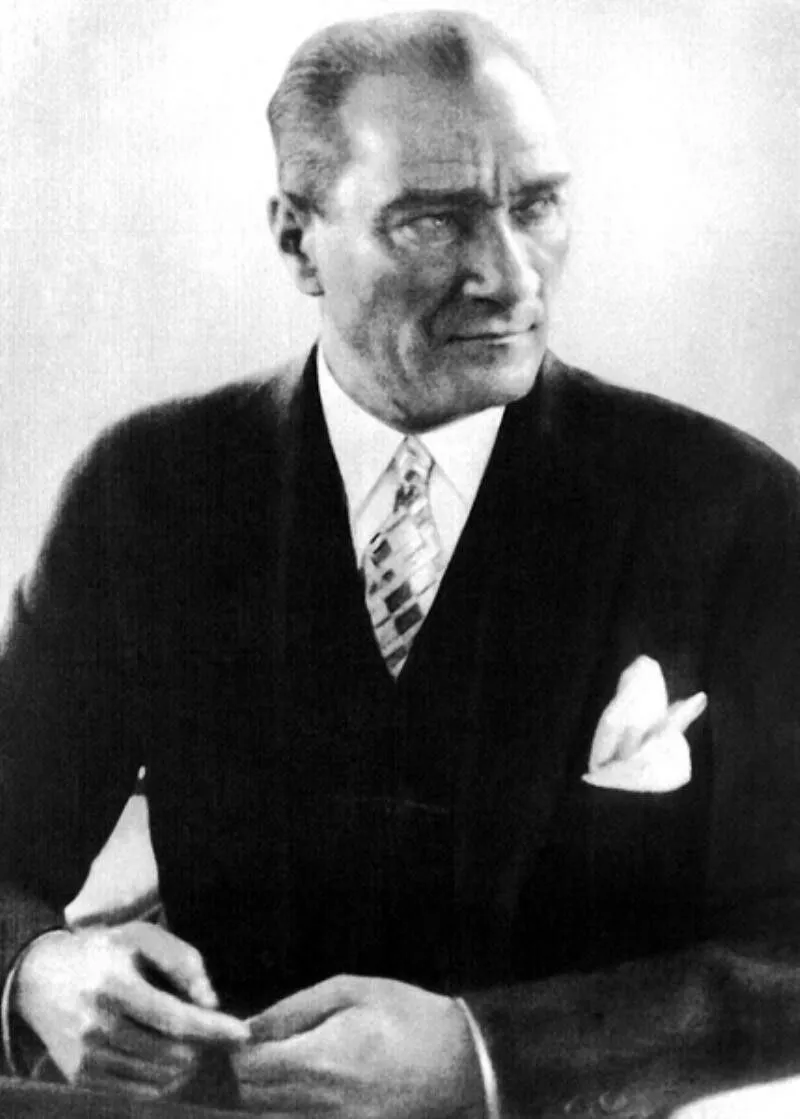
At the beginning of the 20th century, the great Ottoman Empire, once a mighty power, was on the brink of its historical decline. The emergence of modern Turkey — as we know it today — on the ruins of this empire was entirely due to the efforts of a man named Ghazi Mustafa Kemal Pasha, known to the world as Mustafa Kemal Ataturk. He was born on May 19, 1881, in the city of Thessaloniki. Having received a professional military education, he distinguished himself early as a critic of the existing order. He was first arrested for his sharp criticism of the policies of Sultan Abdul Hamid II. He was exiled to Damascus, but even in exile he did not abandon his critical views of the regime existing in the Ottoman Empire. From 1911 to 1915, Kemal Pasha actively and successfully participated in military operations. Under his direct command, a powerful Anglo-French offensive with a landing force on the Gallipoli Peninsula was repelled. In 1916, he was promoted to the high rank of lieutenant general and commanded an army. After the defeat of the Ottoman Empire in World War I in 1918, General Kemal Pasha returned to work at the Ministry of Defense.
In the spring of 1919, Mustafa Kemal Pasha, who believed that the country's independence was under mortal threat, led a revolutionary movement of his like-minded associates who opposed the occupation forces and the sultan's government. In April 1920, Mustafa Kemal Pasha convened his own parliament in Ankara and formed a new government whose primary task was the creation of a new independent Turkish state. In 1923, Mustafa Kemal Pasha founded the Republic of Turkey and was elected its first president, holding this office until his death.
Among the main areas of activity of the new government were large-scale reforms aimed at modernizing the country. Key steps included: the creation of a secular state and a secular education system; the transfer of the capital from Istanbul to Ankara; the adoption of a liberal secular civil code based on the Swiss civil code; the complete separation of religion from the state; the Latinization of the Turkish alphabet; women's suffrage; the introduction of a secular dress code; and the abolition of titles and feudal forms of address. Economic reforms were also carried out to create favorable conditions for private enterprise — in particular, the Law on the Encouragement of Industry was adopted in 1927. Active infrastructure construction and the adoption of plans for the country's industrial development were undertaken.
In 1934, the citizens of Turkey received surnames, which simply did not exist in the Ottoman Empire. The Turkish parliament bestowed upon the head of state himself the surname "Ataturk" ("Father of the Turks" or "Great Turk"). Ataturk also formulated the ideological foundation of the new Turkish state, which became known as "Kemalism." It was based on six principles enshrined in the Constitution of 1937: populism, republicanism, nationalism, secularism, statism (state control in the economy), and reformism.
In the area of national policy, Ataturk pursued a strict course of assimilation, forcing the abandonment of native languages in favor of Turkish. Kurdish uprisings were brutally suppressed, the very concept of "Kurdistan" was removed from books and documents, and the Kurds were declared "mountain Turks." In the 1920s, during the struggle to create the Turkish Republic, Ataturk cooperated with the USSR, accepting its assistance. However, once firmly established in power, he sharply changed course, leading to a cooling of relations between the two countries. In the 1930s, Turkey began drawing closer to Nazi Germany. Mustafa Kemal Ataturk died on November 10, 1938. After his death, Turkey would teeter on the brink of entering World War II on the side of the Nazis, but fortunately managed to avoid it.
Before his death, Ataturk donated his lands to the Treasury and part of his real estate to the municipalities of Ankara and Bursa. On November 10, 1953, Ataturk's remains were reinterred in the specially built mausoleum "Anitkabir" in Ankara. His legacy determined the course of Turkey's development for decades ahead, cementing the secular and nationalist character of the state, despite all the subsequent political changes and challenges the country faced in the middle and late 20th century.