1869 –
1948
India

Mahatma Gandhi
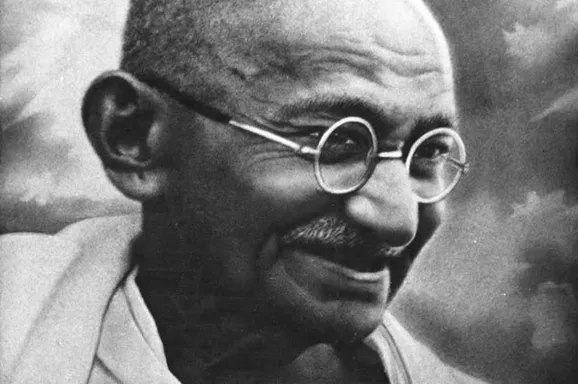
Mahatma Gandhi was born on October 2, 1869, in India into a well-to-do family. The family sent him to London to obtain a legal education. After his studies, Gandhi returned to India, but the opportunity to apply his knowledge he found in South Africa, where at that time many people of Indian origin lived and worked.
In South Africa, Gandhi became a successful lawyer, but he saw clearly the egregious discrimination against representatives of the "colonial race" and the rest of the population, including Africans and Indians. He himself encountered racial discrimination personally. Gandhi was an opponent of armed struggle and as an alternative developed his own method, at the heart of which lay the aspiration to act upon the reason and conscience of opponents. Gandhi defended his convictions by personal example. During the Anglo-Boer War he did not take up arms, but saved lives as a military medic. He exchanged European clothing for Indian, and gave away jewelry and gifts to those in need. The British imperial authorities found themselves seriously perplexed — an eccentric lawyer who kept finding more and more supporters proved to be an opponent against whom they had no methods. The ascetic Gandhi could not be bought, and the man who renounced violence could not be tried for anything. His persistence slowly but surely changed the situation, forcing the colonial authorities to make concessions.
During his South African period, Gandhi became acquainted with the works of L. N. Tolstoy and entered into correspondence with him. This had a great influence on him. Subsequently, Gandhi more than once emphasized that he considered Tolstoy his teacher and spiritual mentor. While in South Africa, Gandhi was repeatedly imprisoned for his actions. It was there that he demonstrated the effectiveness of the principle of non-violent resistance. Gandhi's moral authority among Indians grew rapidly. In 1915, when he returned home from South Africa, the writer Rabindranath Tagore, the Nobel Prize laureate, was one of the first to call Gandhi "Mahatma" ("the great soul"). Here he became close to the Indian National Congress (INC) party and soon assumed the position of one of the key leaders of the national liberation movement, becoming its moral inspirer and ideological leader.
The revolutionary events in Russia influenced the rise of anti-imperialist sentiment in the world. This helped Gandhi realize that, in the struggle with the colonizers, it was necessary to rely on broad strata of society and that only the support of the masses would make it possible to achieve the country's independence. At the same time, Gandhi remained within the framework of his philosophy and preached the resolution of social conflicts through non-violent resistance. Under Gandhi's leadership, the INC was transformed in the period from 1919 to 1947 into a major social movement, becoming a mass and influential national organization. In the 20s and 40s of the 20th century, Gandhi unfolded in India a campaign of religious reconciliation, primarily between Hindus and Muslims, in the name of a united and free India. To a large extent, it was thanks to Gandhi's influence and persistence that a broad nationwide anti-colonial front took shape in the country. In his philosophy and methods, Gandhi relied on a deep knowledge of Indian culture, traditions, and worldview, which made them in tune with the people's ideals. Britain in every way provoked conflicts in India, primarily on inter-religious grounds. In the words of Winston Churchill, "the enmity between Hindus and Muslims served as a bulwark of British rule in India."
Lord George Curzon, who served at the beginning of the 20th century as Viceroy of India (the highest representative of the British Crown), as far back as 1905 carried out the partition of Bengal into Hindu and Muslim parts. This was one of the measures to weaken the movement for independence as part of the policy of "divide and rule." Later, in 1919–1924, while serving as Foreign Secretary of Great Britain, Curzon spoke out against the policy of Soviet Russia in Persia, Afghanistan, and India.
The 1905 partition was a forerunner of the country's future division. Mahatma Gandhi was an opponent of the partition of India into Muslim and Hindu parts, believing that a great country could accommodate representatives of both religions. On January 30, 1948, he was shot during his evening prayer in the courtyard of his home. The assassin belonged to a Hindu nationalist group. The partition of India into Hindu India and Muslim Pakistan after the achievement of independence in 1947 led to numerous casualties and conflicts. Many historians believe that it was the British who laid the foundation for the long-term conflict between the neighboring countries.
At midnight on the night of August 14–15, 1947, the former British possessions in South Asia were partitioned into two independent dominions: the Indian Union and Pakistan. The process of obtaining sovereignty was overshadowed by a large-scale territorial conflict that arose between the two young states.