Cuba

 Play sound
Victory of the revolution
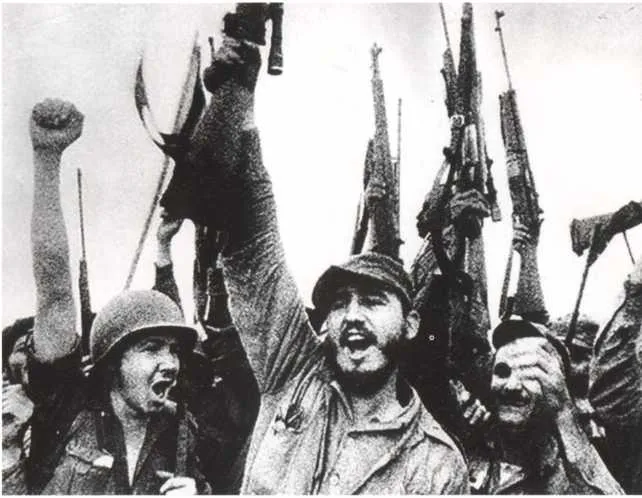
According to the plan they had developed, the uprising was to begin in the Cuban province of Oriente and spread to other regions of the country. On November 25, 1956, the motor yacht "Granma" set off from the Mexican port of Tuxpan with 82 people on board. Among them were Fidel Castro, Raúl Castro, and Che Guevara. Their goal was to seize a foothold on the island from which the rebels would subsequently launch guerrilla operations. On December 2, 1956, the group landed on the eastern coast of Cuba. After a group of 20 rebels managed to establish themselves in an area in the Sierra Maestra mountains, a guerrilla war began in Cuba under the leadership of Fidel Castro. Over the next two years, with the support of the peasants, the revolutionaries gradually advanced from the east to the west of the island. Volunteers from the local population joined their ranks.
On November 15, 1958, Fidel Castro led an offensive toward Santiago de Cuba. In the last days of December, Ernesto Che Guevara's detachment took control of the city of Santa Clara, which opened the road to Havana for the rebels.
On January 1, 1959, Fulgencio Batista fled to the Dominican Republic.
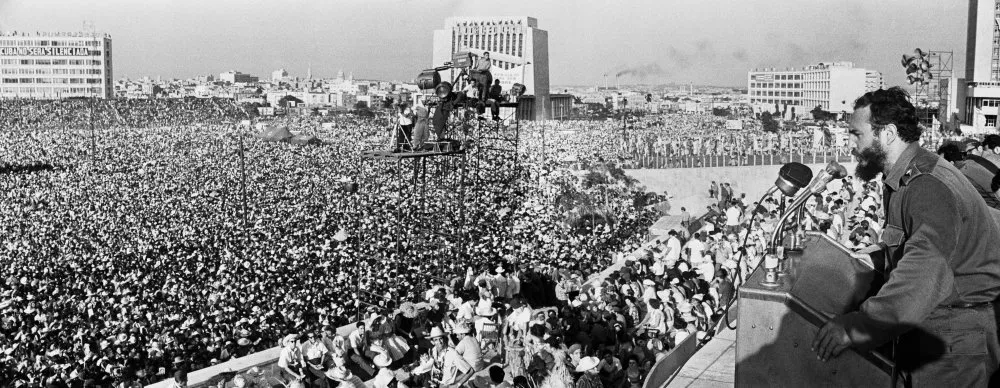
Fidel Castro spoke in the city of Santiago de Cuba, proclaiming the victory of the revolution. On January 8, 1959, his detachment triumphantly entered Havana.
Power in Cuba passed to the Revolutionary Government, headed by Fidel Castro, who became Prime Minister and Commander-in-Chief of the Revolutionary Armed Forces.
After the victory of the revolution, Cuba's relations with the United States sharply deteriorated. Against this backdrop, Cuba drew closer to the Soviet Union, which began purchasing Cuban sugar and supplying the country with oil, food, equipment, agricultural machinery, and other goods. Close cooperation in the military sphere began. In response, the US imposed an embargo on Cuba, and in January 1961 severed diplomatic relations.
In 1961, Fidel Castro declared the socialist character of the Cuban Revolution, which contributed to further rapprochement between Cuba and the USSR. As in other socialist bloc countries, the island carried out nationalization of industry, most private landholdings, transport, communications, and mass media.
In 1962, Castro agreed to the deployment of a Soviet military group of more than 40,000 personnel in Cuba as part of Operation Anadyr. It included four motorized rifle regiments, a missile division, air defense units, air force, and navy units. This was preceded by the deployment of American medium-range Jupiter missiles in Turkey, which could reach Soviet territory. This became one of the causes of the Caribbean Crisis (Cuban Missile Crisis) that began on October 22, 1962, which brought the world to the brink of nuclear war. Through direct negotiations between the leader of the Soviet Union, Nikita Khrushchev, and US President John F. Kennedy, the crisis was resolved. A decision was made to remove the missiles from the island in exchange for concessions from the US and guarantees of non-aggression against Cuba.
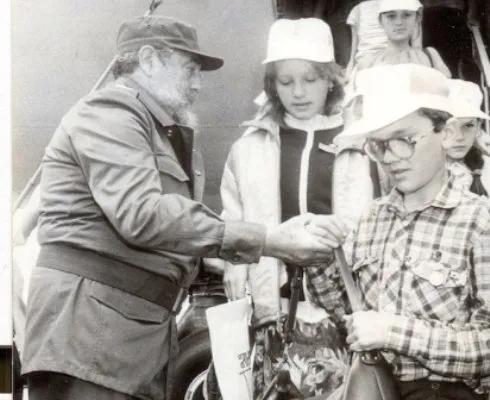
In 1963, Fidel Castro made his first visit to the USSR. After that, he visited the Soviet Union on multiple occasions.
Fidel Castro's first visit to the USSR in 1963 lasted 39 days. Castro was the first foreign leader to be shown the country's strategic facilities, including a launch pad for Soviet intercontinental ballistic missiles and a nuclear submarine, and was given the honor of ascending the tribune of Lenin's Mausoleum. The Cuban leader visited Murmansk, Moscow, Volgograd, Tashkent, Samarkand, Jizzakh, Yangier, Irkutsk, Bratsk, Krasnoyarsk, Sverdlovsk, Leningrad, Kyiv, Tbilisi, and the Black Sea coast of the Caucasus. Fidel managed to walk without guards through nighttime Moscow and talk with ordinary Soviet people. He was awarded the title of Hero of the Soviet Union.
In 1988, Fidel Castro expressed disagreement with perestroika in the USSR, characterizing it as "opposing the principles of socialism."
Throughout all the years Fidel was in power, the Americans made constant attempts on his life, with evidence of 638 such attempts. They tried to poison, blow up, and shoot him, expose him to radiation, chemical substances, and biological weapons, attempted to use poisoned cigars, and even a bomb inside a baseball (Argumenty i Fakty). Despite this, Fidel lived a long life and passed away on November 26, 2016.