1926 –
2016
Cuba

Fidel Castro
After the Spanish-American War of 1898, Cuba emerged from Spanish rule but in fact found itself in the position of a U.S. protectorate. Official independence was proclaimed in 1902. In 1903, the Americans established the Guantánamo naval base on the island. Sugar became the foundation of the Cuban economy. Favorable world market conditions in the early 1920s encouraged the inflow of foreign capital, but the world crisis of the early 1930s significantly affected the island's monoculture economy. In August 1933, against the background of popular discontent, a military junta came to power in which no one held a rank above sergeant. The key figure was Fulgencio Batista.
Fulgencio Batista was born in January 1901 in Cuba. He entered military service in 1921. While a sergeant, he became the trade union leader of Cuban military men. Batista actively engaged in self-education; his favorite hero was Napoleon. Subsequently, he often drew historical parallels between himself and his idol, comparing his return to power by means of a coup in 1952 to Napoleon's return from the island of Elba, while ignoring the fatal outcome of that event. After seizing power in 1933, Batista took the post of chief of the General Staff of the army, effectively controlling the country. The presidents who succeeded one another were of nominal character. All uprisings of opponents were brutally suppressed. Batista acted in the interests of the USA and established contacts with the American mafia. In 1940 he decided to become president and won the elections under the new Constitution. In 1942, Batista established diplomatic relations with the USSR. Cuba, being under the control of the USA, was part of the anti-Hitler coalition and was at war with the Axis countries. In 1944, Batista lost the elections to his rival Ramón Grau and was out of power for 8 years.
In March 1952, the next elections were due to take place. Realizing that he had no chance of winning, Batista organized a coup and seized power. Nevertheless, U.S. President Truman recognized the government as lawful. Returning to power, Batista turned Cuba into a giant casino and brothel; business was controlled by the mafia. In Havana alone there were more than 8,500 brothels. American monopolies controlled almost 70% of the economy; in mining the share reached 90%. The bulk of the land belonged to latifundists, with a significant proportion remaining abandoned. Unemployment stood at 30% of the population, and by 1958 had reached 40%.
Fidel Castro was born on August 13, 1926, in the village of Birán. His father owned a sugar plantation. In 1950 Fidel graduated from the Faculty of Law of the University of Havana, receiving a doctorate in law. During his studies he joined a radical student organization that advocated violent methods of struggle. Later he joined the Party of the Cuban People, which adhered to nationalist and communist ideas. In 1948 he led a delegation of students to a conference in Colombia and took part in the uprising in Bogotá. After his studies he engaged in legal practice. In 1952 he registered as a candidate for deputy, but Batista's coup canceled the elections. In 1953, together with Abel Santamaría, he created the opposition group "Generation of the Centenary" to overthrow the dictatorship.
The struggle against the dictatorship began almost immediately. On July 26, 1953, a small group of revolutionaries led by Fidel Castro attacked the Moncada barracks in Santiago de Cuba. Fidel's younger brother, Raúl Castro, led the assault on the Palace of Justice. Another group, led by Abel Santamaría, attacked the hospital. Abel Santamaría became one of the first martyrs of the revolution. On July 26 he led a group of 24 people to seize the hospital. Most of the group was taken prisoner. Santamaría was arrested, tortured, and killed several hours later. This event marked the beginning of the revolutionary movement which subsequently led to the victory of 1959 and to fundamental changes in Cuba's history.
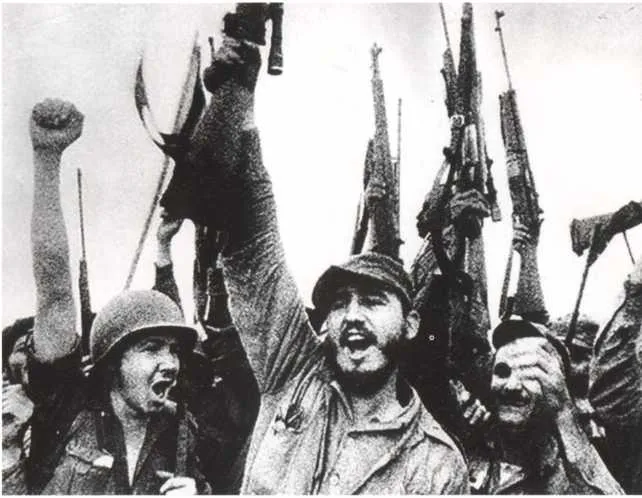
On November 25, 1956, the motor yacht "Granma" set sail from the Mexican port of Tuxpan, on board of which were 82 men. Among them were Fidel Castro, Raúl Castro, and Che Guevara. Their goal was to seize a foothold on the island of Cuba, from which the rebels were subsequently to develop guerrilla operations. On December 2, 1956, the detachment landed on the eastern coast of Cuba. After a group of 20 rebels managed to gain a foothold in a sector of the Sierra Maestra mountains, a guerrilla war began in Cuba under Fidel Castro's leadership. Over the next two years, thanks to peasant support, the revolutionaries gradually advanced from east to west across the island. Volunteers from the local population joined their ranks. On November 15, 1958, Fidel Castro headed the offensive in the direction of Santiago de Cuba. In the last days of December, Ernesto Che Guevara's detachment took control of the city of Santa Clara, which opened the road to Havana for the rebels. On January 1, 1959, President Fulgencio Batista fled to the Dominican Republic. Fidel Castro spoke in the city of Santiago de Cuba with a speech in which he proclaimed the victory of the revolution. On January 8, 1959, the detachment he led entered Havana in triumph. Power in Cuba passed to the Revolutionary Government, which was headed by Fidel Castro, who became prime minister and commander-in-chief of the Revolutionary Armed Forces.
After the victory of the revolution, Cuba's relations with the USA sharply deteriorated. Against this background, a rapprochement took place between Cuba and the Soviet Union, which began purchasing Cuban sugar and supplying the country with oil, food, equipment, agricultural machinery, and other goods. Close cooperation began in the military sphere. In response, the USA imposed an embargo regime against Cuba and in January 1961 broke off diplomatic relations. In 1961, Fidel Castro declared the socialist character of the Cuban Revolution, which contributed to a further rapprochement of Cuba with the USSR. As in other countries of the socialist bloc, the nationalization of industry, of most private landholdings, of transport, of means of communication, and of mass media was carried out on the island.
In 1962, Castro agreed to the deployment in Cuba, as part of Operation "Anadyr," of a Soviet troop grouping numbering more than 40,000 men. It included four motorized rifle regiments, a missile division, units of air defense, the Air Force, and the Navy. This was preceded by the deployment in Turkey of American medium-range "Jupiter" missiles, which could reach Soviet territory. This became one of the causes of the start, on October 22, 1962, of the Cuban Missile Crisis, which brought the world to the brink of nuclear war. As a result of direct negotiations between the leader of the Soviet Union, Nikita Khrushchev, and U.S. President John Kennedy, the crisis was settled. A decision was made to remove the missiles from the island in exchange for concessions from the USA and guarantees of non-aggression against Cuba.
In 1963, Fidel Castro made his first visit to the USSR. After this he visited the Soviet Union repeatedly. The first visit of Fidel Castro to the USSR in 1963 lasted 39 days. Castro was the first foreign leader to be shown the country's strategic facilities; in particular, he was shown the launch pad for Soviet intercontinental ballistic missiles, an atomic submarine, and was given the honor of mounting the rostrum of Lenin's Mausoleum. The Cuban leader visited Murmansk, Moscow, Volgograd, Tashkent, Samarkand, Jizzakh, Yangiyer, Irkutsk, Bratsk, Krasnoyarsk, Sverdlovsk, Leningrad, Kyiv, Tbilisi, and the Black Sea coast of the Caucasus. Fidel managed to walk through nighttime Moscow without security and to converse with the simple Soviet people. He was awarded the title of Hero of the Soviet Union.
In 1988, Fidel Castro expressed disagreement with perestroika in the USSR, characterizing it as "opposing the principles of socialism." All the years that Fidel was in power, the Americans staged constant assassination attempts against him (according to various data, there were 638). They tried to poison him, blow him up, shoot him, expose him to radiation, chemical agents, biological weapons, tried to use poisoned cigars, and even a bomb inside a baseball. Despite this, Fidel lived a long life and passed away on November 26, 2016.