Cuba

 Play sound
Cuban independence
The Spanish colonization of Cuba began after Christopher Columbus discovered the island in 1492. The indigenous population of the island — the Indians — was almost completely exterminated, and slaves from Africa began to be brought to the island to work on plantations. In the 19th century, the liberation movement on the island intensified, resulting in the Ten Years' War (1868–1878) and the War of Independence of 1895.
The leader of the uprising that began in 1868 was the lawyer Carlos Manuel de Céspedes. He freed his slaves and led a detachment in the Oriente province in the east of the island, and very soon the entire eastern part of Cuba was in the hands of the rebels. In April 1869, a constituent assembly was convened, which adopted the first constitution of Cuba, proclaiming Cuba as an independent republic, abolishing slavery, and declaring all inhabitants free. The guerrilla commanders Máximo Gómez and Antonio Maceo proposed advancing westward across the island until total victory was achieved. Other participants in the movement favored a compromise with Spain. The war continued for several more years and ended with the preservation of Spanish colonial rule and minor concessions — expanded rights in municipal governance and the judiciary, a general amnesty, and partial abolition of slavery.
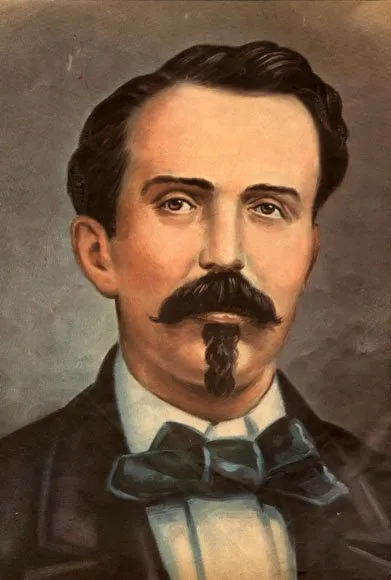
A new struggle for liberation lay ahead, led by José Martí (1853–1895). He came from a military family. His childhood and youth coincided with the years of the Ten Years' War. In 1869, he published a handwritten school journal "Free Homeland" featuring his verse drama "Abdala," whose main character, a Nubian chief, liberates his homeland from foreign enslavers at the cost of his own life. The drama brought Martí fame but provoked the anger of the colonizers. The author was sentenced to hard labor in quarries and then exiled to Spain. While in Spain, he studied law, literature, and philosophy at the universities of Madrid and Zaragoza, then worked in Mexico and Guatemala. In 1878, he received permission to return to Cuba, but in 1879 was again exiled to Spain. From 1881, he lived in the United States, collaborating with various newspapers and magazines. He called for the unity of Latin American peoples and the fight for Cuba's independence. Together with the veterans of the Ten Years' War, Maceo and Gómez, he launched active preparations for a new armed uprising in Cuba. Analyzing the causes of the failures of the Ten Years' War, he understood the need to create a political party to lead the revolutionary movement. As a result, in 1892, the Cuban Revolutionary Party was founded, whose official organ became the newspaper "Patria" ("Homeland"), published in the United States and distributed underground in Cuba. He sought to unite all supporters of Cuba's independence; in February 1895, he landed on Cuba in Oriente province with a landing party but was killed on May 19, 1895, during a battle with the Spanish. The party created by José Martí continued the struggle, led by Máximo Gómez, Antonio Maceo, and Calixto García. The Spanish authorities unleashed real terror against the rebels and the local population that supported them. The wave of resistance and popular anger grew. The Spaniards were close to capitulation. But at that moment, in June 1898, US troops landed on Cuba, and the island was occupied by US forces that had entered the war with Spain. It was not for nothing that the Spaniards called Cuba the "Pearl of the Antilles." The US saw the island as a prize; Cuban industry passed into the hands of American capital, the rebel army was disbanded, the US controlled the island's foreign policy, and obtained land for military bases, one of which — Guantánamo — remains in Cuba to this day.
On May 20, 1902, Cuba was proclaimed an independent republic, but true liberation was still far away. The ideas of José Martí inspired a new generation of Cuban patriots.
José Martí left a great ideological, political, and literary legacy. In Cuba, he is called the "Apostle of Independence." Many of his statements have become famous quotations. In examining the historical process, Martí drew on a materialist approach. He was able to reveal the neocolonial essence of American capitalism and became one of the first ideologues of purposeful anti-imperialist struggle. He saw this as a new stage in the national liberation movement.