06.10.2026
A brief analysis of the elections in Brazil and the challenges ahead
Beatriz Bissio Federal University of Rio de Janeiro Bandung Spirit Network 5 October, 2026
Democracy in Brazil is facing its greatest test since the restoration of constitutional order in the mid-1980s and the adoption of the new Constitution in 1988.
In this general election—for the presidency, Congress, governors, and state legislatures—Brazil is divided between two candidates who differed profoundly from one another: on one hand, that of President Lula, who is seeking reelection—in what would be his fourth, non-consecutive term—on a platform of defending sovereignty, democracy, and the state as a driver of social justice; and on the other, the candidacy of Flávio Bolsonaro, the eldest son of former President Bolsonaro, who cannot run because he is in prison and has been stripped of his political rights.
Flavio Bolsonaro’s candidacy advocates extreme neoliberalism, including the dismantling of the state’s social safety programs, uncritical alignment with U.S. interests—particularly Donald Trump’s agenda, including the alliance with Israel and all that it represents—as well as extreme individualism and a devotion (genuine or cynical?) to the values preached by neo-Pentecostal churches regarding customs and morality. All of this is without mentioning the corruption scandals in which he is under investigation, his statement in favour of handing over rare earths and critical minerals to the United States, the photos of him conspiring with the representative of what would be the Brazilian equivalent of the Epstein case in USA and his ties—which he has never denied—to hired killers and paramilitary groups (known here as “milicianos”).
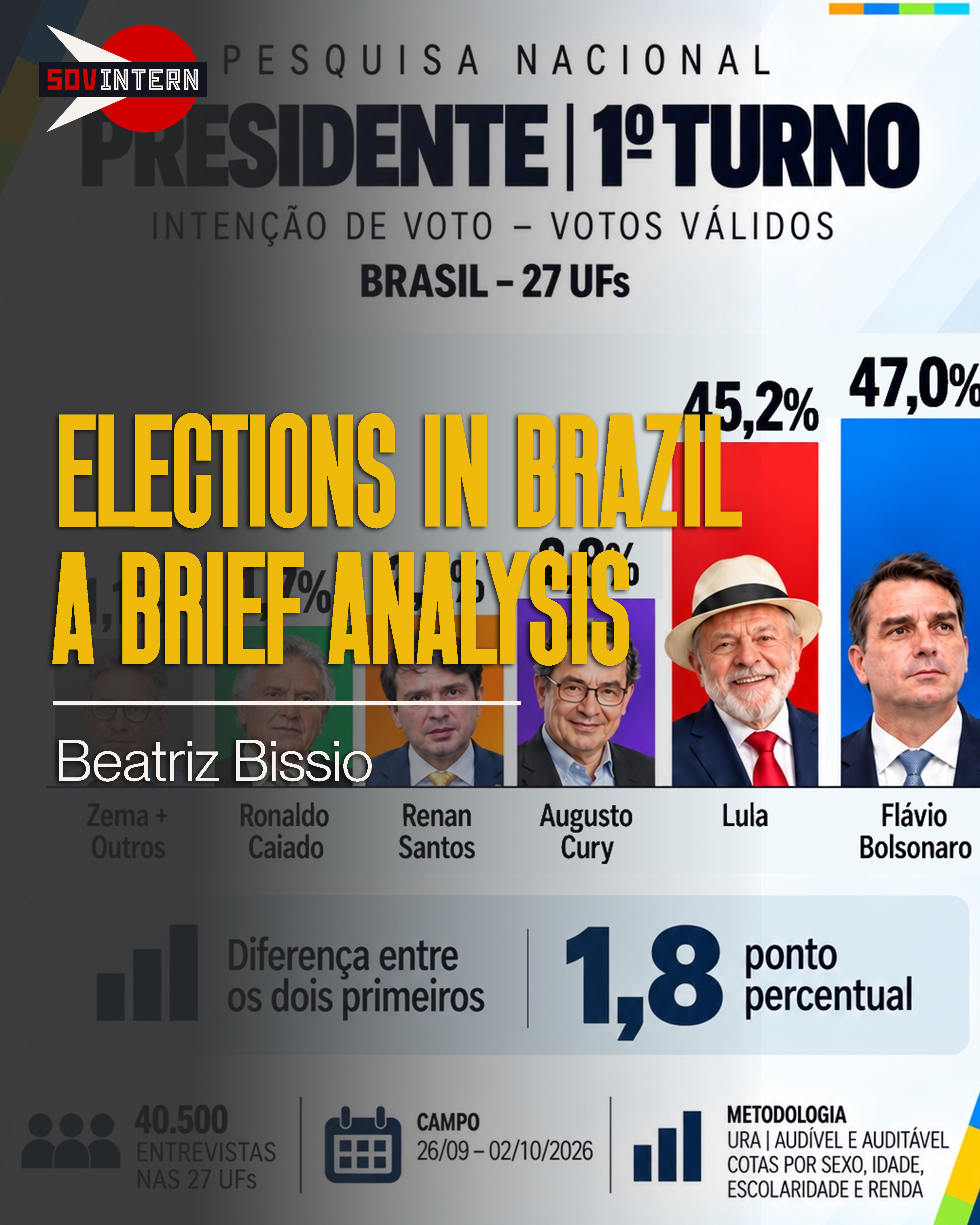
The election will be decided in a second round on 25 October. Flávio Bolsonaro came out on top with 48 per cent of the vote, whilst Lula came second with 45 per cent.
The future of the whole of Latin America, and in particular South America, will depend to a large extent on the outcome of the Brazilian election, given Brazil’s demographic, economic and political weight. This conviction is clearly evident, on the one hand, in the highly significant statements of support received by Lula from various social and political sectors across Latin America, and, on the other, in the numerous allegations – which are currently being investigated by the Federal Police – of interference by the United States (read: the Trump administration) in the election campaign, and indeed long before that.
The high abstention rate – over 20 per cent of the electorate – and the drop in the number of votes received by President Lula in Sunday’s election (4 million fewer votes than in 2022 – and only two million votes separate him from Flávio Bolsonaro) reveal a sense of discontent amongst a certain segment of the electorate due to the high cost of living and the levels of violence (which the mainstream press takes it upon itself to highlight time and again), real problems faced in their daily lives by a large proportion of the poorer working-class electorate, the unemployed or those who make a living through delivery apps, for whose ears Bolsonaro’s more direct and even brutal message may sound more convincing.
To overcome this sense of unease and disappointment with democracy, alternatives to this bitter daily reality must be shown. And to do this, it must be demonstrated that the oppressive system – neoliberalism – is the culprit that must be fought. Contrary to what the neo-Pentecostal churches preach, there are no ‘individual solutions’. Nor is the failure that leads to depression and even suicide an individual matter. Failure stems from a complete lack of support for political proposals that have no backing to challenge this system.
None of this is easy to explain in an election campaign. It is even worse in campaigns where social media spreads fake and biased news, and the mainstream media plays into the hands of neoliberalism, glorifying fiscal austerity and wage cuts whilst condemning any investment in support of the most vulnerable and in high-quality public services (education, healthcare, transport). It is therefore necessary, with a view to the medium and long term, to establish ongoing political education initiatives – something which, regrettably, the left in these latitudes abandoned long ago. And now, during this three-week campaign, we must roll up our sleeves, take to the streets to talk to those who abstained from voting, and remember the blood that thousands of Brazilians shed so that we might enjoy the right to vote today!
No comments yet. Be the first.