1797 –
1830
Venezuela

Venezuelan independence
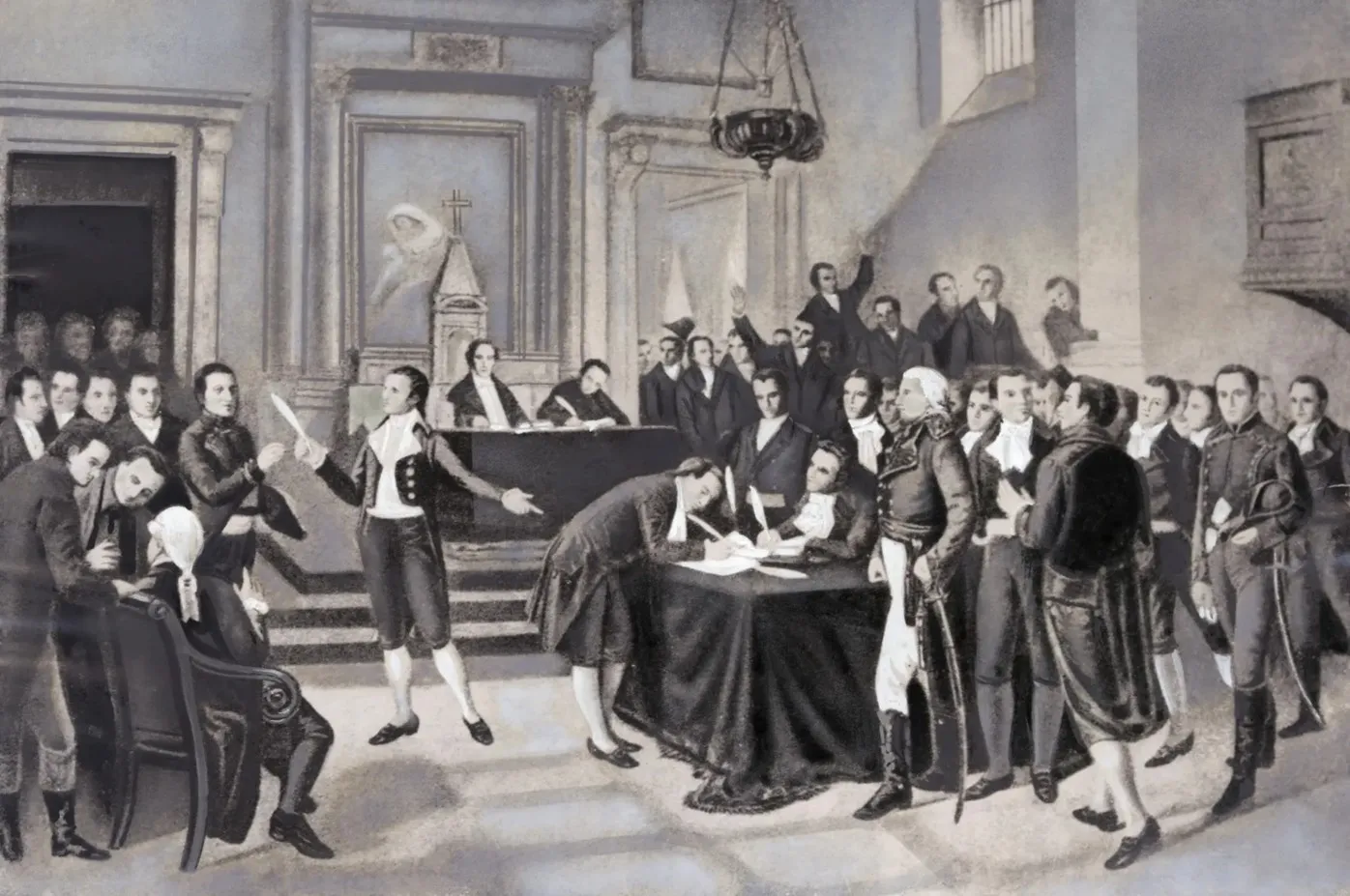
The history of Venezuela's achievement of independence is one of the most complex episodes of the Latin American revolutions of the early 19th century. The process stretched over decades of struggle and led to the collapse of Spanish domination. The roots of separatism go back to the end of the 18th century, when the ideas of the Enlightenment and the events in France penetrated the minds of the Creole elite of Caracas. The Creoles, despite their economic influence, felt their rights were being infringed upon compared with the Spaniards, which created fertile ground for discontent with the metropolis's trade policy. The first manifestation was the conspiracy of Manuel Gual and Jose Maria Espana in 1797, which was quickly suppressed but laid the ideological foundation. The precursor to the war was Francisco de Miranda, who undertook several unsuccessful expeditions, the culmination of which was the landing at La Vela de Coro in 1806, which ended with a lack of popular support. The turning point came after the Napoleonic invasion of Spain in 1808, when the captivity of King Ferdinand VII created a power vacuum. In Caracas, a junta arose that set a course toward autonomy. On July 5, 1811, the Congress of the Provinces of Venezuela proclaimed full independence, establishing the First Venezuelan Republic. The document was inspired by declarations of human rights, but the republic proved unstable due to internal disagreements and the lack of support from the popular masses. A blow came with the earthquake of March 26, 1812, which destroyed patriot fortresses. The clergy interpreted this as divine punishment, undermining morale. As a result of the counter-offensive by the troops of Domingo de Monteverde, the First Republic fell. Miranda, who signed the capitulation, was arrested by his comrades and handed over to the Spaniards, where he soon died. Simon Bolivar enters the stage. Having refused to recognize the capitulation, he fled to New Granada and organized the Admirable Campaign in 1813, liberating western Venezuela. The Second Republic was proclaimed. Bolivar issued a decree of war to the death, lending the conflict its brutality. However, the uprising of the llaneros led by Jose Tomas Boves led to the defeat of the patriots at the Battle of La Puerta in 1814. Bolivar emigrated once again, leaving the country at the mercy of terror. The years 1815-1816 became a time of reassessing strategy. In Jamaica and Haiti, Bolivar realized the necessity of social support from the lower classes, promising the abolition of slavery and granting land to soldiers. The assistance of Haitian President Alexandre Petion made it possible to secure mass support. The return in 1817 laid the foundation for the Third Republic with its base in Guayana (Angostura). Bolivar delivered the Angostura Address. The strategy changed: first to liberate New Granada. In 1819, Bolivar's army, including the British Legion, made the crossing of the Andes and defeated the Spaniards at the Battle of Boyaca, opening the road to Bogota. This led to the creation of the Republic of Gran Colombia, uniting the territories of modern Venezuela, Colombia, and Ecuador. However, the final consolidation of independence of the Venezuelan territories occurred later. The decisive battle took place on June 24, 1821, at Carabobo. Patriotic forces inflicted a crushing defeat on the royalist army, which predetermined the outcome of the war, although isolated pockets of resistance held out for several more years. The victory at Carabobo is annually celebrated as the main national holiday. After the military successes, the political phase began. Bolivar dreamed of a unified state to counter intervention, but centrifugal forces proved stronger. Regional caudillos, such as Jose Antonio Paez, sought local power. By 1830, Gran Colombia had disintegrated, and Venezuela withdrew from it as a sovereign state. This moment is considered the final formation of Venezuelan statehood. The price of independence was high: the country lay in ruins, the population had halved, and the economy was devastated. Bolivar, disillusioned with the political fragmentation, left his post and soon died in exile in Santa Marta. The process transformed the social structure, formally abolishing slavery, and drew the broad masses into politics. In subsequent decades the country experienced a period of caudillismo, but the institution of the republic held firm. The memory of the war of independence remains the central axis of political culture. The image of Bolivar is used by various forces as a symbol of freedom. The path from the first declaration in 1811 to the final recognition of sovereignty took almost two decades. The Spanish Empire was unable to hold onto its possessions, despite fierce resistance. Independence became the result of a combination of internal demand, leadership, international circumstances, and military fortune, consolidated in battles from Boyaca to Carabobo. This birth of a nation changed the map of the Western Hemisphere forever.