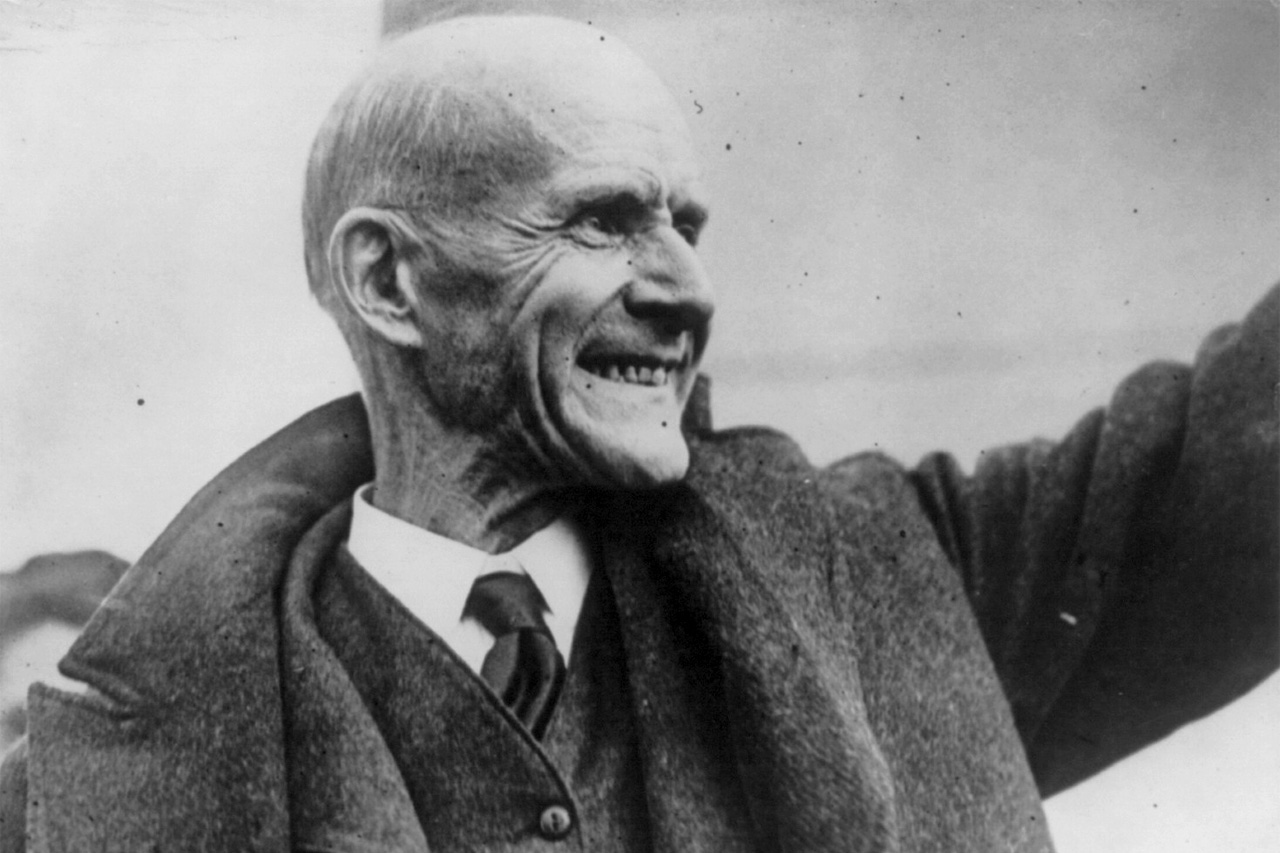
1855 –
1926
USA

Eugene Debs
Eugene Victor Debs occupies a unique place in the history of the United States of America. He was not merely a politician or a trade union leader, but a symbol of the working class's struggle for its rights in an era of rapid industrial growth and social inequality. Debs became the most renowned socialist in U.S. history, a man who ran for president of the country five times on the Socialist Party ticket and managed to attract millions of voters to ideas considered radical in the American mainstream. His life spans the period from 1855 to 1926, a time when America was transforming from an agrarian republic into an industrial superpower, and it was Debs who became the voice of those left behind by this progress.
Debs's early years were spent in Terre Haute, Indiana. At the age of 14, he dropped out of school and began working as a boiler cleaner on the railroad. That work determined his entire subsequent destiny. He quickly advanced up the career ladder, becoming a locomotive fireman, and soon displayed a talent for organizing. At 22, Debs became the secretary of the local branch of the Brotherhood of Locomotive Firemen, and later edited the union's magazine. Initially, his views were far from socialism; he believed in harmonious cooperation between labor and capital. However, the reality of the brutal exploitation of workers, low wages, and dangerous working conditions gradually changed his outlook. He came to understand that narrow craft unions could not effectively stand up to the power of large corporations, and he advocated for the creation of industrial unions uniting all workers in an industry regardless of their specialty. In 1893, Debs founded the American Railway Union, one of the first industrial organizations in the country. The culmination of his union activities was the famous Pullman Strike of 1894. Workers at the Pullman company, which manufactured railway cars, went on strike over wage cuts while rents remained high in the company town. The union supported them by boycotting trains carrying Pullman cars throughout the country. This paralyzed rail traffic in the western United States.
The federal government intervened on the side of business, sending in troops and obtaining a court injunction. Debs and other leaders were arrested for contempt of court. Six months of imprisonment in Woodstock jail became a turning point in Debs's life. It was in that cell that he began to study deeply the works of Karl Marx and other socialist theorists, and became acquainted with the ideas of evolutionary socialism. He emerged from prison a convinced socialist, declaring that as long as there was a capitalist class, there would also be a working class, and that the task was to abolish the very system of wage labor. After his release, Debs devoted himself to building the socialist movement. In 1901, he became one of the founders of the Socialist Party of America. His oratorical talent was legendary; he could speak for hours without notes, appealing to the emotions and reason of workers, farmers, and intellectuals. Debs ran for president of the United States five times: in 1900, 1904, 1908, 1912, and 1920. His best result was achieved in 1912, when he received about 900,000 votes, which amounted to roughly 6 percent of the total electorate. That was a record for a socialist candidate in the United States. At the time, socialists controlled numerous local governments, published hundreds of newspapers, and had representatives in Congress. Debs's platform included demands for public ownership of the railroads and mines, the introduction of old-age pensions, unemployment insurance, a ban on child labor, and the granting of voting rights to women. Many of these ideas were later implemented within the framework of Franklin Roosevelt's New Deal. Debs's political position was based on a Marxist analysis of class society, but adapted to American democratic realities. He did not call for armed insurrection, but believed in the possibility of a peaceful transition to socialism through the ballot box and union struggle. For him, socialism was not merely an economic system but an ethical imperative. He believed that capitalism was by its very nature immoral, because it placed profit above human life. Debs advocated the international solidarity of workers, asserting that the working class has no fatherland within the framework of bourgeois states. His rhetoric was filled with images of brotherhood and justice. He often said that as long as there is one poor person at the bottom, there can be no wealth at the top, and that he wished to belong to those who are in need, rather than to those who need protection of their privileges.
A special place in Debs's biography belongs to his uncompromising stance on the First World War. While the majority of European socialist parties supported their governments in the war, the American socialists under Debs took an antiwar position. They regarded the war as a slaughter benefiting only capitalists and arms magnates. In June 1918, in Canton, Ohio, Debs delivered his most famous speech, openly condemning the war and calling for resistance to the draft. He declared that the ruling class declares wars while the working class fights and dies. Shortly thereafter he was arrested under the Espionage Act of 1917. The court found him guilty of incitement to disobedience, and he was sentenced to 10 years in prison. Even while in federal prison in Atlanta, Debs did not cease his political activity. In 1920, he ran for president once again from his cell and received more than 3 percent of the vote. His imprisonment provoked a broad public outcry and protests. Many considered him a political prisoner. In 1921, the new president Warren Harding pardoned Debs, in part because of the politician's deteriorating health.
After his release, Debs continued to lecture, but his strength had been undermined by imprisonment. He died in 1926 at a sanatorium in Elmhurst, Illinois. The legacy of Eugene Debs remains significant to this day. He laid the foundation for the modern trade union movement in the United States, demonstrating the power of workers' solidarity. His struggle for social justice anticipated many reforms of the 20th century. For left-wing movements, he remains an icon of integrity and principle. Debs never compromised his conscience for the sake of political gain. His life showed that a serious political alternative to the dominant parties is possible in the United States, even in the face of fierce resistance from the system. Debs's name is often invoked by contemporary progressive politicians, who see in him a forerunner of the struggle for economic equality. His famous words, that he wished to be remembered not as a man who strove for power, but as a man who loved his fellow human beings, reflect the essence of his life's philosophy. In the history of America, he remained the voice of the nation's conscience in an era of unbridled capitalism.