Uruguay

 Play sound
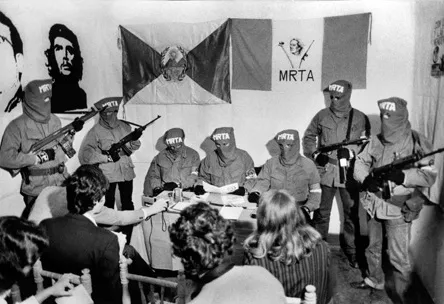
Tupamaros
Juan María Bordaberry came to power in 1972 following the 1971 elections, although it was acknowledged that his victory had been rigged. As president, he suspended civil liberties, banned trade unions, carried out repressions against the left-wing opposition, and appointed military officers to key government positions. He supported far-right "death squads" in their fight against the "Tupamaros" or the "National Liberation Movement" — a radical left-wing Uruguayan organization.
In the 1960s, when a wave of insurgent revolutionary movements swept across many Latin American countries, it also reached Uruguay. This small-population country was called the "Switzerland of Latin America." Uruguay had neither the destitute Brazilian favelas nor the impoverished Central American villages, no dominance of the military and oligarchs, no ruthless latifundistas or drug lords. An active protest environment simply did not exist in the country. Nevertheless, educated young people in Uruguay formed the National Liberation Movement, and the name Tupamaros was borrowed from Peruvian indigenous rebels of the 18th century (Túpac Amaru II — a forerunner of the war of independence in the region in the late 18th – early 19th century). Uruguay's population consisted of descendants of European immigrants.
It all began in 1959. At that time, a young lawyer and member of the Socialist Party, Raúl Sendic, organized the poorest and most socially vulnerable workers — sugar industry laborers — into a union. In 1962, Sendic led them on a march to Montevideo, but along the way the protesters were dispersed by the police — with beatings and arrests.
After the "march on Montevideo," Raúl Sendic, Eleuterio Fernández Huidobro, and several other young members of the socialist party, anarchists, and Maoists began preparing for guerrilla warfare.
The Tupamaros considered themselves soldiers in the worldwide struggle against capitalism and imperialism. Their native Uruguay was for them merely a dot on the map: they fought for the cause of the Viet Cong, the Palestinians, for the oppressed Guatemalan and Peruvian indigenous peoples, against the regimes of Franco, Salazar, and the Greek "Black Colonels," against apartheid in South Africa, and so on. In 1965, they detonated a bomb at the office of the German chemical company Bayer.
In 1970, the rise to power in Chile of left-wing forces led by Salvador Allende inspired the Uruguayan left, who formed an analogue of the Chilean Popular Unity — the Broad Front (Frente Amplio), which included communists, socialists, and Christian democrats. The leader of the FA and presidential candidate was General Líber Seregni.
One of the founders of the Broad Front was the long-time leader of the Communist Party of Uruguay, Rodney Arismendi (1913–1989). A member of the Communist Party of Uruguay since 1930. In 1940–1941, he served as editor-in-chief of the central organ of the Uruguayan Communist Party — the newspaper "Justicia." In 1941–1944, he was editor-in-chief of the communist newspaper "Diario Popular." From 1946 to 1973, he was a member of parliament. From 1955 to 1985, he served as First Secretary of the Central Committee of the Communist Party of Uruguay. In January 1975, he was exiled from Uruguay to the USSR. Rodney Arismendi's daughter, Marina Arismendi, led the Communist Party of Uruguay within the Broad Front from 1992 to 2006.
The wave of violence from the Tupamaros and retaliatory violence from the authorities continued to escalate. Under these conditions, in June 1973, President Bordaberry, relying on the army, carried out a coup. Political parties were banned, trade union activities were suspended, and democratic freedoms were abolished. All the forces of the state apparatus were directed at suppressing the Tupamaros. The movement's leaders and active fighters were arrested and imprisoned. President Bordaberry, intoxicated by victory, decided to completely abolish democracy in Uruguay and turn it into something resembling Franco's Spain. In 1976, he proposed that the army liquidate the institutions of representative democracy, govern the country through a Council of the Nation composed of military officers, and replace elections with referendums — much as Nazi Germany had replaced elections with plebiscites. But this was too much for the Uruguayan army: it removed Bordaberry from the presidency. The army, considering the task of suppressing the insurgents accomplished, began a slow liberalization that culminated in 1985 with the restoration of democracy and free general elections.
In the new, post-dictatorial Uruguay, the restored FA became one of the main political forces (alongside the historic Blanco and Colorado parties). It was once again led by Raúl Sendic, who had survived torture and suffering through 13 years of imprisonment. The new Tupamaros completely renounced violence, recognized democracy as a fundamental value, stopped rejecting private property, abandoned Marxism-Leninism, and condemned the armed struggle they had once waged. The Tupamaros transformed into a Scandinavian-style social democratic party. On December 14, 2008, one of the former active fighters of the Tupamaros, José Mujica, was elected President of Uruguay. He became one of the best heads of state in the country's history: under his leadership, economic growth went hand in hand with an improvement in the population's standard of living.