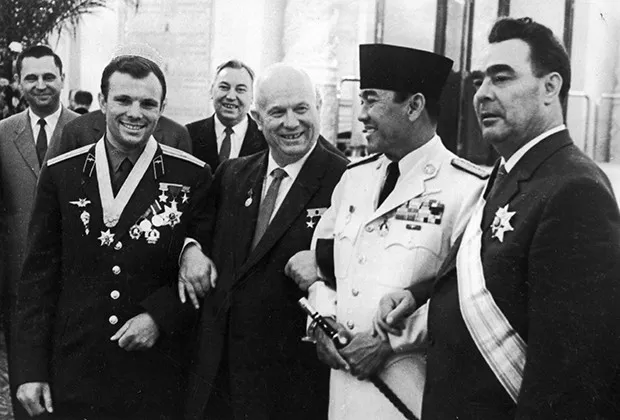
Indonesia

 Play sound
Ahmed Sukarno
Ahmed Sukarno (Kusno Sosrodihardjo) (1901–1970)
Indonesia is one of the most populous countries in the world, with over 250 million people currently living there.
Until 1949, Indonesia was a colony of the tiny Netherlands.
It was called the Netherlands East Indies, and the national liberation movement, despite its large numbers and popular support, could not overthrow the rule of the Dutch colonizers.
The catalyst for the process of liberation from colonial dependence was the victory of the Soviet Union in World War II. At the origins of Indonesian independence stood Ahmed Sukarno, who became the first president of independent Indonesia. He called himself a socialist, although he was never a follower of Marxist doctrine — Sukarno's views represented a fairly typical combination for Asian and African countries of that era, blending socialist ideas with anti-imperialist nationalism.
Indonesia had been part of the Dutch empire since the late 16th century. The main instrument of penetration and expansion was the United Dutch East India Company (VOC), founded in 1602. By the end of the 17th century, after several wars and territorial conquests, the VOC had extended its authority over the entire island of Java (the most densely populated island in the world and the third-largest island of the archipelago after Sumatra and Sulawesi, where the capital of modern Indonesia — Jakarta — is located).
Sukarno was born on June 6, 1901, into a wealthy family. His father practiced Islam, and his mother practiced Hinduism. Thus, he united within himself the two main religions of his homeland. He received a higher education in construction and architecture, after which he worked as an architect and builder, which, however, did not prevent him from entering politics.
His ideology was a blend of Marxism, Islamism, and nationalism. It combined all three currents that were popular in Indonesian society at the time. His oratory skills and inherent magnetism and charisma had a mesmerizing effect on listeners. He was repeatedly arrested for agitation against the colonial authorities. In prison, he devoted himself to self-education and loved reading. Sukarno spoke five foreign languages fluently.
On July 4, 1927, a founding congress was held in Bandung, at which the National Party of Indonesia was established; it existed until 1931.
In the spring of 1942, having suppressed the brief and weak resistance of Dutch colonial forces, Japan occupied the Dutch colonial territory of Indonesia. During the Japanese occupation, Sukarno collaborated with the Japanese, believing that the Asian Japanese were better for Indonesia than the Dutch. He even joined the Committee for the Preparation of Indonesian Independence created by the Japanese.
On August 7, 1945, three days after Japan's surrender, Indonesia proclaimed its political independence. The Central National Committee of Indonesia was formed, which approved the top leaders of the sovereign state. Ahmed Sukarno was proclaimed president of independent Indonesia.
The Dutch did not want to accept the loss of their colony. The Indonesian War of Independence lasted three years. The Dutch managed to capture Ahmed Sukarno and a number of other leaders of the country. However, through the mediation of the United Nations, the release of the Indonesian leaders was achieved. On August 23, 1949, a conference was held in The Hague, and on August 17, 1950, Indonesia was once again proclaimed an independent state.
Subsequently, in the 1960s, Sukarno's foreign policy actions and his domestic economic policies led to major problems and growing contradictions, which ultimately resulted in his removal from power.