1919 –
present
Greece

Greek Communists
History knows many paradoxes, but the fate of the Greek expeditionary corps in Russia stands apart. The communist movement in Greece received a powerful impetus precisely thanks to the soldiers who had originally been sent… to invade the young Soviet Republic in order to suppress revolutionary power!
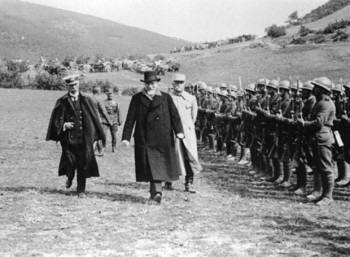
In 1919, at the height of the Russian Civil War, the French command, which exercised overall direction of the Entente operations in southern Russia, presented an ultimatum to the Greek government of Eleftherios Venizelos. Athens decided to support the allies and dispatched 23,351 soldiers and officers to the frozen steppes of Ukraine in support of the White movement.
The presence of the Greek troops on this territory became an unprecedented and traumatic experience for them. Conditions of service were unbearable: the soldiers suffered from a lack of proper armament and a complete absence of cavalry support. Through the criminal negligence of French logistics, the troops went hungry and sleep-deprived. They were left without reserves and deprived of even the most minimal support from the French contingents, which, in fairness, were themselves composed of the least combat-capable elements France could field. The situation was further aggravated by the practical absence on the ground of the White Guards (supporters of the tsarist regime) and counter-revolutionaries to whose aid they had come. Moreover, the Greek interventionists encountered determined resistance from the local population, which actively supported the revolution.
As a result, the Greek soldiers effectively avoided combat operations. This generates a historical paradox: despite a two-year campaign in an active combat zone, the corps's losses amounted to only 1,055 men killed and wounded.
The situation changed after the Red Army took Odessa, Kherson, and Sevastopol. The allied troops began a hasty evacuation from Russian territory. On April 15, 1920, the last units of the Greek corps found themselves surrounded by the Reds in Sevastopol. However, instead of execution or captivity, the new Soviet authorities, having demanded that they surrender their arms, showed humanity: they facilitated the orderly retreat of the Greeks into Bessarabia. From there, the troops were transported by sea to Smyrna.
Returning home, the participants in the ill-fated "Ukrainian campaign" brought back with them not only memories but also new ideas. They scattered to their villages and city quarters, becoming the first cells of Greek Bolshevism and founding the Communist Party of Greece.
Historical continuity can also be traced further. It is no coincidence that the majority of the senior officers of ELAS (the People's Liberation Army of Greece) — the left-wing partisan resistance movement of 1941–1945 — came precisely from this army corps sent to Ukraine in 1919. The experience gained in Russia was transformed into the struggle against fascism two decades later.
The evolution of these men's consciousness is eloquently illustrated by the songs they sang before and after the campaign.
Setting off for Russia, the soldiers sang with patriotic pathos:
What is the snow, the Bolsheviks and the cannons to us? We have heart and youth, Youth, full of life!
But homeward they returned to different motifs, reflecting a complete change in ideological orientation:
We do not want armies and fleets, No borders on the earth, No people scheming To break our souls. Down with the bogeyman and the lie, Hope is enough, For a new society We will fight, my children!
Thus, the attempt to strangle the revolution by fire and sword turned out the way that the very executors of this will became its sincere supporters and continuators.