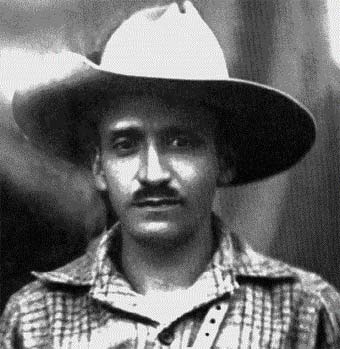
1893 –
1932
El Salvador

Agustín Farabundo Martí
Agustín Farabundo Martí is a key figure in the history of the revolutionary movement of Latin America. He was born on May 5, 1893, into a wealthy family in El Salvador. Having received a university education, he became interested in left-wing ideas at an early age. From 1920 to 1929, Martí traveled through the region, taking part in political movements. An important stage was his time in Nicaragua, where he collaborated with Augusto Sandino in the struggle against the American intervention. Martí held the position of chief of staff in Sandino's army. His international experience and Marxist views made him an authority among Latin American revolutionaries.
In 1931, he returned to El Salvador, where a social crisis was brewing. In January 1932, Martí led a peasant uprising against the dictatorship of Maximiliano Hernández Martínez. The uprising was triggered by the cancellation of elections and the worsening condition of the peasantry. However, the forces were unequal. The army brutally suppressed the revolt. Farabundo Martí was arrested and executed by firing squad on February 1, 1932. Together with him, thousands of participants in the uprising perished. The period of repression, known as "La Matanza," claimed the lives of up to 30,000 people, predominantly indigenous. Despite the defeat, Martí's name became a symbol of resistance. For many years his memory was preserved underground, banned by official propaganda. In the 1980s, his name was immortalized in the title of a new revolutionary organization.
From 1970 to 1979, the political crisis in El Salvador intensified. Right-wing death squads killed trade union and church activists. In response, leftist groups set a course for armed struggle. On October 10, 1980, five different guerrilla organizations merged into the "Farabundo Martí National Liberation Front," abbreviated as FMLN. The coalition included the Popular Liberation Forces, the Revolutionary Army of the People, the National Resistance, the Revolutionary Party of Central American Workers, and the Communist Party. This unification made it possible to coordinate military operations against the government army.
The civil war officially began in 1980 and lasted 12 years. The FMLN controlled significant territories in mountainous and rural areas. The insurgents created zones of self-government where they implemented social programs. The United States government provided large-scale military assistance to the regime in El Salvador, fearing the spread of socialism after the Sandinistas' victory in Nicaragua. The conflict was characterized by great cruelty on both sides. About 75,000 people perished, and hundreds of thousands became refugees. The culmination was the guerrilla offensive on the capital in November 1989. It showed that a military victory by the regime was impossible, which pushed the parties toward negotiations. On January 16, 1992, the Chapultepec Peace Accords were signed in Mexico City. The document put an end to the war and defined the terms of democratization. The FMLN laid down its arms and transformed into a legal political party. Former guerrillas received guarantees of security and the right to participate in elections. A reform of the armed forces was carried out and a new civilian police force was created. This process became an example of a successful transition from armed struggle to democracy. In 1994, the party participated in elections for the first time, winning seats in parliament.
The political path of the FMLN was long. The party strengthened its positions at the local level, winning the mayoralties of major cities. In 2009, a historic breakthrough took place. The FMLN candidate, Mauricio Funes, won the presidential election. This was the first time the left came to power in the country peacefully. The Funes administration implemented social programs aimed at reducing poverty. In 2014, the former guerrilla commander Salvador Sánchez Cerén became president. His rule continued his predecessor's course but ran into economic difficulties and rising crime. However, by the end of the 2010s, the popularity of the socialists declined. Accusations of corruption and ineffectiveness weakened the party. In the 2019 elections, the FMLN candidate lost to Nayib Bukele. The new government began dismantling the institutions created after the war. The FMLN lost influence in the legislature. Despite this, the organization's legacy remains significant. The Front played a key role in the victory over the dictatorship and the establishment of democracy. The name of Farabundo Martí continues to be associated with the struggle for social justice in Central America. The history of the FMLN demonstrates the complexity of the transition from revolution to governing the state under conditions of globalization.