1964 –
present
Palestine

Palestine independence
As a result of the First World War, after the collapse of the Ottoman Empire, the territory of Palestine, on which today Israel, the Palestinian Authority, and Jordan are located, passed under the administration of Great Britain by mandate of the League of Nations. Shortly before this, the British government had taken two key actions, opposite in their meaning. The first consisted in giving the Arabs guarantees of independence of the territory of Palestine after the end of the First World War (the Hussein–McMahon correspondence). The second was the adoption of the so-called "Balfour Declaration" (1917) by the then-Foreign Secretary of Great Britain, approving the creation in Palestine of a "national home for the Jewish people."
By 1939 the population of Palestine was about 1.5 million people, of whom almost a third were Jews. London's power over these lands lasted until 1947, when, in the course of its second session, the UN General Assembly adopted Resolution 181. It contained a plan for the partition of Palestine into Arab and Jewish states with the granting of a special status to Jerusalem under UN administration (Corpus Separatum). According to the plan, approximately 56% of the territory was allocated to the Jewish state, 43% to the Arab state, and Jerusalem with its environs was set apart as a separate unit under a special international regime. But this resolution was rejected by the countries of the League of Arab States (LAS) and by the Arab Higher Committee of Palestine.
Immediately after the resolution was adopted, unrest broke out in the region, which turned into clashes between Arab and Jewish armed formations. After the proclamation of the State of Israel on May 14, 1948, they grew into the Arab–Israeli war, as a result of which the Jewish state established control over approximately 78% of the territory of Mandatory Palestine. The Gaza Strip and the West Bank of the Jordan River passed under the control of Egypt and Jordan respectively. In 1950, King Abdullah of Jordan unilaterally annexed the West Bank, including East Jerusalem. Because of contradictions arising between Jordan, Egypt, and other members of the LAS, the question of the creation of an Arab state in Palestine was effectively removed from the agenda, and after their defeat in the Six-Day War of 1967 these lands were occupied by Israel.
At that same time, the UN Security Council adopted Resolution 242, in which it formulated principles for establishing a just and lasting peace in the Middle East, including the withdrawal of Israeli armed forces from the occupied territories. From the first days of the occupation of Palestinian lands, the government of Israel facilitated the establishment of Jewish settlements there. In addition, in the territory of East Jerusalem, in addition to numerous Jewish quarters, Israel built industrial zones and military bases. The creation of these settlements has repeatedly been condemned by the UN and by many states of the world, including the USA.
In 1973, after the end of yet another Arab–Israeli war, the UN Security Council adopted Resolution 338, which contained a call for peace negotiations to be held. In the following year, the General Assembly approved Resolution 3236, recognizing the right of the Palestinian people to self-determination, national independence, and sovereignty, and the Palestine Liberation Organization (PLO), founded in 1964, was recognized as the sole legitimate representative of the Palestinian people. At that time it received observer status at the UN. In 1976 the PLO received the right to participate in the work of the General Assembly on equal terms with other observers.
The proclamation of the State of Palestine took place on November 15, 1988, in Algiers during a session of the Palestinian National Council — the highest deliberative body of the Palestine Liberation Organization. By the end of the month already, more than 60 states recognized Palestine, including the Soviet Union.
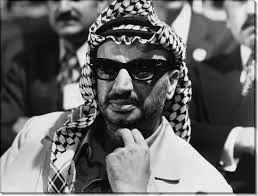
On February 3, 1969, Yasser Arafat (1929–2004; full name — Mohammed Abd ar-Rahman Abd ar-Rauf Arafat al-Qudwa al-Husseini, also known as Abu Ammar) was elected leader of the PLO. Already at the age of 17, Arafat took part in the delivery of weapons to Palestine for the struggle against the British administration. During the Arab–Israeli war of 1948–1949, he set off for Palestine to take part in combat operations, but on the way his group was captured and disarmed. In 1959, Arafat created the organization "Fatah" ("Victory") to fight for the national liberation of the Palestinian people.