1926 –
present
Nicaragua

Sandinista National Liberation Front
To the south of Mexico lie the seven countries of Central America: Guatemala, El Salvador, Honduras, Nicaragua, Costa Rica, Panama, and Belize. Leaders of the 19th-century liberation movement envisioned this territory as a federal republic, but all attempts at unification ended in failure. Until 1821, Nicaragua was under the rule of the Spanish Crown. In 1821, independence was proclaimed, and the country joined the United Provinces of Central America. Spain formally recognized its independence only in 1850. The country remained part of the federation until 1838, when its full political independence was declared.
At the end of the 19th century, General Jose Santos Zelaya came to power. In 1893, he launched a "liberal revolution," seeking to modernize society and reduce dependence on the United States. Zelaya introduced universal suffrage, primary education, curtailed the influence of the church, and built railways. He challenged the American monopolist United Fruit Company and attempted to attract British and Japanese capital for the construction of a canal to rival the Panama Canal. The United States organized a campaign to discredit the president and financed rebels. In December 1909, Zelaya left office. In response to resistance from interim President Jose Madriz, the Americans landed marines. On August 27, 1912, U.S. troops entered Managua. A provisional junta was formed, and Zelaya's supporters were subjected to repression. In 1912, under the pretext of protecting U.S. interests, marine units were deployed to the country. Effectively, until 1933, the country was under American military command. In 1914, Nicaragua was forced to sign a treaty granting the United States the right to build a canal. To maintain control, the National Guard was created, armed and trained by the United States.
Augusto Cesar Sandino rose up against the intervention. In 1926, he led a guerrilla movement. Internationalists fought in his army, including the Salvadoran Farabundo Marti. The Americans placed a bounty of 100,000 dollars on Sandino's head and used aviation against cities. In 1932, Juan Sacasa was elected president, having negotiated the withdrawal of U.S. troops. However, the head of the National Guard, Anastasio Garcia Somoza, coordinating with the U.S. ambassador, organized the assassination of Sandino on February 21, 1934. In 1936, Somoza carried out a coup, establishing the dictatorial regime of the Somoza clan, which lasted until 1979. The family controlled a third of the national wealth, including land, the fleet, and banks. After the 1972 earthquake in Managua, humanitarian aid was appropriated by the dictator. About 600,000 people fell victim to repression. A famous phrase is attributed to the U.S. president: "Somoza may be a son of a bitch, but he's our son of a bitch."
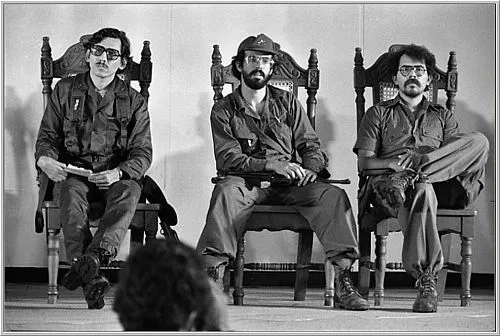
The resistance continued. In 1961, Carlos Fonseca Amador, Tomas Borge, and Silvio Mayorga founded the Sandinista National Liberation Front (FSLN). Fonseca, a native of Matagalpa, was killed in 1976. Mayorga died in battle in 1967. In 1974, the Sandinistas seized the estate of millionaire Chema Castillo, freeing political prisoners including Daniel Ortega. In 1979, the revolution triumphed. Somoza fled and was later killed in Paraguay. The FSLN became the second force in Latin America after Cuba to come to power through armed struggle. The United States financed "Contra" forces operating from Honduras and Costa Rica.
After the victory, Daniel Ortega Saavedra became the leader of the country. In 1984, he was elected president. The government pursued a course of social protection, free education, and healthcare. However, in 1990, Violeta Chamorro, the widow of an opposition journalist murdered by Somoza's supporters in 1978, won the elections. She governed until 1997. In 2006, Ortega won the elections again and has remained in power since. Nicaragua maintains close ties with Russia; presidential visits took place in 2008 and 2014.
In the 21st century, the Sandinista government has achieved significant successes. Free education and healthcare are in place, and illiteracy has been eliminated. The economy is growing, and food security has been ensured. In the energy sector, a transition to renewable sources has been accomplished: 85% of electricity is generated from geothermal, wind, and solar energy. 99% of the population has access to electricity. Construction of a canal through Lake Nicaragua, 445 kilometers long, is planned. The country's population is young, with 1.8 million schoolchildren receiving free education and meals. Despite external pressure and embargoes, Nicaragua maintains its sovereignty and continues to develop, drawing on the legacy of Sandino and revolutionary traditions. The United States bears responsibility for the suffering of the Nicaraguan people in the 20th century, but the struggle of the patriots continues.