Egyptian independence

Egypt

Play sound

Egyptian independence

Formally, Egypt remained an Ottoman province until 1914, although throughout the 19th century it became increasingly autonomous. In 1867, the Ottoman sultan granted Egypt the status of an autonomous vassal state (khedivate). In 1869, the construction of the Suez Canal was completed. In 1875, due to a treasury deficit, the Egyptian share of canal company stocks was sold to the British government. Thus the canal became Anglo-French. In 1881, a revolt erupted against British policies. London sent troops and in 1882 occupied the country. Egypt fell under British control, although it formally belonged to the Ottoman Empire. England became the sole administrator of the canal. On November 5, 1914, Egypt was declared a British protectorate.

From the beginning of the 20th century, Arab nationalism gained strength in Egypt, oriented toward modernization and liberation from foreign governance. In November 1918, the Wafd ("Delegation") Party was founded. The founder of the liberal-nationalist organization was Saad Zaghloul (1857–1927). In March 1919, after Zaghloul's arrest, mass protests erupted across all segments of the population. The idea of national liberation united people despite social and religious divisions. Australian and New Zealand corps units were deployed to suppress the demonstrations. As a result of the clashes, 800 Egyptians were killed and 1,600 wounded. The wave of protests forced the British authorities to make concessions, and Zaghloul was released.

At the end of February 1922, the British authorities recognized Egypt's political independence. The Wafd became the leading party. On January 26, 1924, Saad Zaghloul became Prime Minister. In Egyptian history, he is remembered as a resolute patriot who recognized the necessity of political and economic modernization, the development of market relations, and constitutional democracy. Zaghloul was convinced of the uniqueness of Egypt's path and called for the unification of the people beyond religious differences. The reconciliation of Muslims and Copts was possible only under conditions of societal modernization and the abstraction of ideology from religious disputes.

Neighboring Sudan was considered an Anglo-Egyptian condominium but was governed by the British. Nationalists demanded the transfer of Sudan to Egypt. In November 1924, the Sirdar of the Egyptian Army, the Englishman Lee Stack, was assassinated in Cairo. London used the murder as a pretext for pressure. The Egyptian leadership agreed to comply with the demands but insisted on its interests in Sudan. The British forcibly turned Sudan into a colony, suppressing uprisings. Zaghloul resigned. After his death in 1927, the party was led by Mustafa el-Nahhas Pasha. Despite the support of the Wafd, the king pushed through a new constitution, and from 1930 a royal dictatorship was established with the support of British troops.

Parallel to the secular patriotism of the Wafdists, in the second half of the 1920s, a religious-fundamentalist opposition began forming in Egypt. The Muslim Brotherhood emerged, rejecting capitalism and the Western way of life. After Italy's invasion of Ethiopia, Britain softened its policy. In May 1936, the Wafd won the elections and Nahhas Pasha became Prime Minister. In December 1937, King Farouk dismissed him. The Wafd boycotted the elections. In August 1939, a non-party government was formed, headed by Ali Maher, who held pro-German sympathies. Egypt did not declare war on Germany until 1945, and the Chief of the General Staff cooperated with the Italians.

In postwar Egypt, discontent with the king and corruption grew. The defeat in the war with Israel in 1949 intensified protests within the officer corps. In the summer of 1949, the secret organization "Free Officers" was formed. It was led by Lieutenant Colonel Gamal Abdel Nasser (1918–1970). In January 1952, anti-British demonstrations ended in clashes. The army turned against the regime. On the night of July 22–23, 1952, the troops of the Free Officers entered Cairo. In 1953, the monarchy was abolished and Egypt was proclaimed a republic. Power passed to General Muhammad Naguib. Naguib became Chairman of the Revolutionary Command Council, with Nasser as his deputy.

However, tensions between them intensified. Nasser advanced a radical program. In October 1954, the Muslim Brotherhood made an unsuccessful assassination attempt on Nasser. This allowed him to eliminate his opponents. In November 1954, Naguib was removed and power passed to Nasser. On July 26, 1956, Nasser announced the nationalization of the Suez Canal. The canal was closed to Israeli vessels. The result was the Suez Crisis of 1956: military operations by Israel, Britain, and France against Egypt. The conflict was ended through the efforts of the United States and the USSR. The failure of the intervention boosted Nasser's popularity across the Arab world.

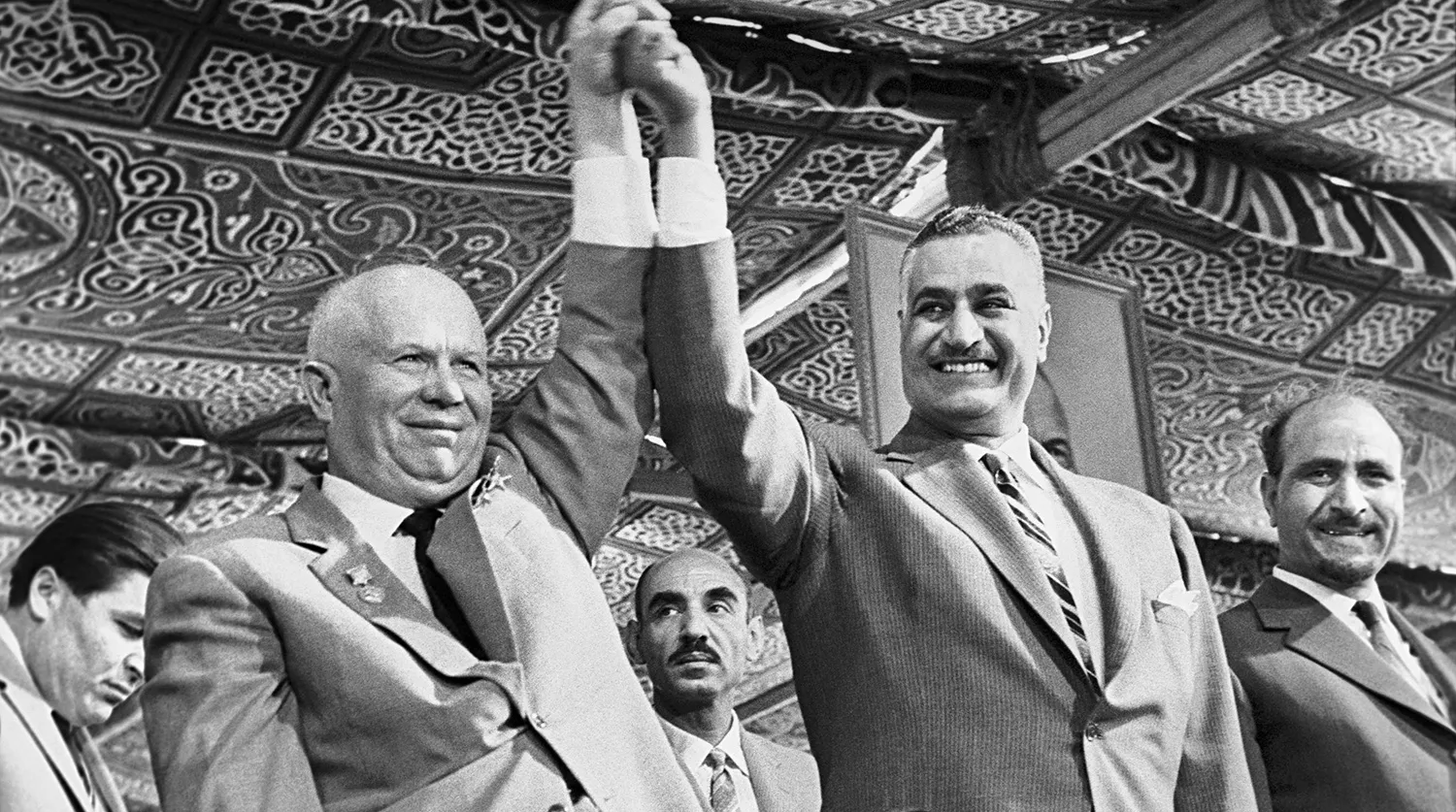
Nasser was regarded as a leader capable of resisting Western colonialism. His name is associated with the unification of Egypt and Syria into the United Arab Republic. As a proponent of Arab nationalism, Nasser adhered to Arab socialism. The core of his policy was the nationalization of industry and strategic sectors. The social program included a minimum wage, free education and healthcare, and affordable housing. An agrarian reform was carried out to protect the interests of peasants. An enormous contribution was made to defense capability, industrial development, and infrastructure. In 1960, with the assistance of the USSR, construction of the Aswan High Dam began. It was built over 11 years and opened on January 15, 1971. The hydroelectric complex provided half of Egypt's electricity. Nasser sought to limit the influence of religion while recognizing Islamic values.

Nasser supported national liberation movements (Algeria, Yemen). Despite suppressing communists, he maintained good relations with the USSR. In 1964, Nasser was awarded the title of Hero of the Soviet Union. A serious defeat was the Six-Day War in June 1967, in which Israel defeated a coalition of Arab countries. On September 28, 1970, Gamal Abdel Nasser died of a heart attack at the age of 52.

Arrow left